
Dati Bendo / European Union via Wikimedia Commons
Deterrence by Self-Defense?

Iulian Romanyshyn
University of Bonn
Dr. Iulian Romanyshyn is a DAAD/AGI Research Fellow in Fall 2025.
Dr. Iulian Romanyshyn is a senior fellow and lecturer at the Center for Advanced Security, Strategic and Integration Studies (CASSIS) at the University of Bonn. He is also the head of the scientific program at the Institute for International Cooperation, Technological Diplomacy and Communication (ICI) and an advisor at CMI - Martti Ahtisaari Peace Foundation. He previously held research and teaching positions at New York University, Maastricht University, Free University of Brussels, and European University Institute, as well as research fellowships at the NATO Defense College, the Academy of International Affairs NRW, and the Charlemagne Prize Academy. Iulian holds a PhD in political science from the IMT School for Advanced Studies Lucca, master’s and bachelor’s degrees from Maastricht University, College of Europe (Bruges), and the National University of Kyiv-Mohyla Academy.
Iulian’s research focuses on transatlantic security relations, EU security and defense policy, Black Sea security, and EU-Ukraine relations. He has published widely in many peer-reviewed journals, including the Journal of Common Market Studies, International Journal, Journal of European Integration, European Foreign Affairs Review, International Politics, and European Security, and contributed to a number of leading think tanks, including the Atlantic Council, Carnegie Europe, and the German Institute of Development and Sustainability. Iulian's research has been acknowledged with the Global Strategy PhD Prize awarded by the Egmont Institute for International Relations and the European Security and Defence College.
Iulian’s research project at AGI will focus on the question of security guarantees for Ukraine. Based on the concept of sufficient deterrence, he explores a series of measures that will allow Ukraine to build a sufficient capacity to defend against Russia’s ongoing war to the point that Russia is deterred from repeating its aggression in the future. In addition, the project examines how the push to provide security guarantees for Ukraine recalibrates the transatlantic burden-sharing and redefines the relations between the United States and Europe in security and defense.
Ukraine, Security Guarantees, and Transatlantic Relations
Ever since Russia invaded Ukraine in 2014, seized Crimea, and occupied parts of the Donbas region, a major question confronting transatlantic policymakers has been whether to provide Ukraine with military assistance and, if so, what sort. The debate has only intensified after Russia’s full-scale invasion of Ukraine in 2022, which reinforced the point that Ukraine, if left without Western support, is highly vulnerable to the Kremlin’s imperialist designs. This debate reached a boiling point during the dispute between the U.S. and Ukrainian presidents at the White House meeting at the end of February 2025. When pressed by Trump and his team on the question of peace talks, Zelenskyy insisted that Kyiv will not accept any deal that fails to provide security guarantees to ward off a renewed Russian invasion. Russia continues to maintain its maximalist war objective of subjugating Ukraine, and this, coupled with Moscow’s proven record of flouting international agreements, suggests that any peace deal would likely be a temporary one. Crafting a postwar security arrangement that would deter Russia, reassure Ukraine, and strengthen the transatlantic alliance is of paramount importance.
Security guarantees and deterrence
The notion of security guarantees, often used interchangeably with the term security assurances, implies a commitment of one actor to come to the aid of another actor if it is threatened or attacked.[1] Security guarantees can take various forms. One way to provide security is to form an alliance, a written agreement between two or more states, in which “members pledge to come to each other’s aid in the event that one member experiences external aggression.”[2] Article 5 of NATO’s Washington Treaty or Article 5 of the U.S.-Japan Security Pact are the best examples of mutual defense commitments. Academic studies confirm that such defensive alliances constitute a gold standard of security guarantees, since they reduce the probability of military conflict.[3] Another way to ensure security is to provide a partner with military equipment. Arms transfers are an imperfect substitute for treaty-based security guarantees, but they also signal a certain level of commitment between allies: “The bigger the arms transfer, the more valuable the relationship.”[4]
Security guarantees work through the mechanism of deterrence. In a nutshell, deterrence is defined as dissuasion by means of a threat. Successful deterrence typically involves a combination of two elements—capability and credibility.[5] Defending actors need to hold capabilities with which they can enforce a deterrent threat over its adversary; they also need demonstrate credibility with respect to their determination to use such capabilities. Another important distinction is between the deterrence by punishment and deterrence by denial.[6] Deterrence by denial is based on threatening that an adversary will not achieve its goals, while deterrence by punishment threatens to impose severe penalties on an aggressor if an attack occurs. In other words, “punishment deters through the fear of pain, [while] denial deters through the fear of failure.”[7]
U.S. views on security guarantees for Ukraine
The history of Western policy toward Russia over the past twenty years is marked by a consistent failure to deter Russia from invading its neighbors.[8] Concerned about escalation, U.S. and Europeans governments did not threaten or impose meaningful costs on Russia before 2022, undermining their credibility.[9] Similarly, measures to deny the Russian objective of a quick victory in Ukraine—by massively arming Kyiv or by pre-emptively deploying armed forces on the ground—have been out of consideration.
After Russia annexed four Ukrainian regions in September 2022, the question of Ukraine’s membership in NATO came to the forefront of Ukraine’s relations with the Western partners. The Biden administration considered whether NATO accession for Ukraine would be feasible but ultimately decided against supporting it. Senior national security officials in the Biden team believed that admitting Ukraine would incur massive escalation risks for the United States in confronting nuclear-armed Russia. [10]
Unlike the previous U.S. government, the Trump administration has a minimalist vision of the U.S. defense role toward Europe and favors a settlement with Russia. Senior U.S. officials from the outset ruled out Ukraine’s membership in NATO. The Trump administration expects Europeans to take responsibility for security guarantees for Ukraine, offering only vague language about how the United States might enable European support in the post-war period. Regardless of the scale of the U.S. backstop, it seems unlikely to involve American boots on the ground in Ukraine.
European responses to the shifting U.S. transatlantic posture
Faced with the diminishing U.S. posture on the European stage and growing questions about American reliability, European allies are confronted with a dilemma. In crafting a viable response to the transatlantic policy shifts of the Trump administration, they were faced with a choice of keeping Washington on board or preparing for its absence. It seems that Europeans have decided to pursue both options in parallel.
On one track, European efforts are geared toward acquiescing to U.S. preferences in order to keep the United States engaged. When Zelenskyy openly confronted Trump in the White House in February 2025, this resulted in an abrupt suspension of all military assistance to Ukraine. Hence, Europeans agreed to buy U.S.-made weapons for Ukraine, take over the full financial burden to keep Ukraine’s economy running and accept the unfavorable trade deal with Washington. All these steps were meant to ensure that the United States does not pull the plug on remaining support to Ukraine, leave Europeans to face the Russian threat alone, or lose interest in peace and stability in Europe altogether. The risk of balancing an openly hostile United States seems to outweigh the price that Europe needs to pay by bandwagoning with the United States.
On the other track, Europe is bolstering its military capabilities for the scenario it must defend itself against Russia without the United States. The European Commission has launched the Rearm Europe program with the objective to invest €800 billion in defense by 2030, while NATO member states agreed on the new defense spending target of 5 percent of GDP. The capabilities for which Europe relies on the United States—and which its defense planners would need to replace—include strategic airlift, intelligence, surveillance, reconnaissance, and long-range precision strikes. The IISS estimates that it would take at least a decade to build an independent European conventional deterrent with a price tag of $1 trillion. This forecast does not, however, dovetail with mounting intelligence threat assessments alerting that Russia could launch an attack on a NATO country as soon as 2029.
Crafting a reliable security guarantee for Ukraine
As NATO’s protective umbrella remains out of reach in the immediate term and transatlantic relations enter a state of flux, Ukraine’s own military capabilities take the center stage in a deterrence policy toward Russia. At the core of an arrangement guaranteeing the country’s security is Ukraine’s internal strength that would allow it to effectively deter and, if necessary, defend itself against a renewed Russian invasion. Ukraine’s indigenous security guarantee can be complemented, but not substituted, by an external component in the form of multinational force deployment that is being developed by the European “coalition of the willing.” Drawing on both types of deterrence (denial and punishment), this security arrangement would be informed by two rationales: obstructing Russian battlefield objectives and imposing costs for a renewed Russian invasion.
Security guarantee core: Ukrainian armed forces
With more than ten years of battlefield experience of holding Russia back, the Ukrainian armed forces are the most important tool of a credible deterrence regime. Prior to 2014, Ukraine’s military forces had been in a prolonged state of decay. With defense expenditures at less than 1 percent of GDP, Kyiv could barely summon 5,000 combat-ready troops to defend itself against Russian intervention in Crimea and eastern Ukraine. Ever since, Ukraine’s defense expenditure has grown exponentially, reaching 34 percent of GDP in 2024—the highest military burden in the world. The number of active military personnel increased from 165,000 in 2013 to 900,000 in 2024, making Ukraine’s armed forces the largest army in Europe.
Despite having a highly capable and credible military that proved to be successful at denying Russian objectives on the battlefield, Ukraine is dependent on military assistance from its partners. In early 2025, President Zelenskyy revealed that more than 100 combat brigades at the frontline are not properly equipped. Air defense systems are the most critical shortfall. The U.S.-made Patriot missile batteries, in addition to long-range artillery and ammunition, are at the top of the Prioritized Ukraine Requirements List, a mechanism that European NATO countries launched to fund and supply U.S.-manufactured weapons to Ukraine after President Trump halted American military aid.
With more than ten years of battlefield experience of holding Russia back, the Ukrainian armed forces are the most important tool of a credible deterrence regime.
A critical gap in Ukraine’s military capabilities is long-range missiles and air forces. Ukraine has developed deep strike drone capabilities that have taken out more than a third of Russian oil refineries, inflicting damage on the Russian economy and society. Kyiv has also recently tested a homegrown Flamingo cruise missile. Ukraine needs to scale up these efforts with a massive purchase and production of cruise and ballistic missiles with a range over 1,000 km.[11] These capabilities will enable Ukraine to put at risk something that Putin’s regime values the most: energy infrastructure and military facilities. The Tomahawk missiles greenlighted by the Pentagon for Ukraine would fit well into this effort to build a capable deterrent by punishment; President Trump appeared to flirt with providing them but backed off in late 2025 when he renewed his administration’s push for a settlement.
Another element in the deterrence toolbox is Ukraine’s defense industry, which has become a major source of growth and innovation in the country. According to Ukrainian leaders, as much as 60 percent of weapons used on the frontline are domestically made. What is more, Ukraine can produce up to 20 million drones next year, ten times more than in 2024. The country’s revived defense industry now has an output of $35 billion per year, but the government can fund only half of this capacity. Denmark became the first country to acknowledge and meet the challenge. Copenhagen started to procure directly from the Ukrainian defense industry because of cheaper production costs and faster delivery times. Furthermore, in March 2025, the EU published a White Paper on European Defense, which pledged to tie the Ukrainian defense industry with the European defense technological landscape. This effort was framed as a part of the “porcupine strategy,” so that Ukraine is able “to deter any possible further attacks and ensure a lasting peace.” This pledge was followed with the launch of the EU’s Security Action for Europe (SAFE) initiative that provides €150 billion in loans to member states to finance common defense procurement, while integrating Ukrainian defense industry into joint projects.
Along with ramping up the European defense industrial base, European governments would be well-advised to buy directly from Ukrainian defense companies, as well as to foster co-production agreements and technology sharing. Moreover, European partners should help Ukraine boost its air force and produce long-range missiles on a large scale. Military assistance to Ukraine should be guided by the principle of a qualitative deterrence balance, in which partners help Ukraine match or offset Russian military advantages with superior equipment. All of these would require Europeans to step up their financial support of Ukraine on a durable rather than ad hoc basis. To meet this challenge and to avoid external borrowing, Ukraine’s partners—specifically EU member states—would need to deploy hundreds of billions of euros in frozen Russian assets currently lodged in their financial institutions.
Security guarantee supplement: European troops in Ukraine
A desirable supplement to Ukraine’s domestic capabilities is the presence of European troops in Ukrainian territory. The possibility of sending military force to Ukraine was first proposed by French President Macron in early 2024. It was presented in the context of a discussion of how to seize the escalation initiative from Russia on the ground, but the idea was not met with enthusiasm among allies.
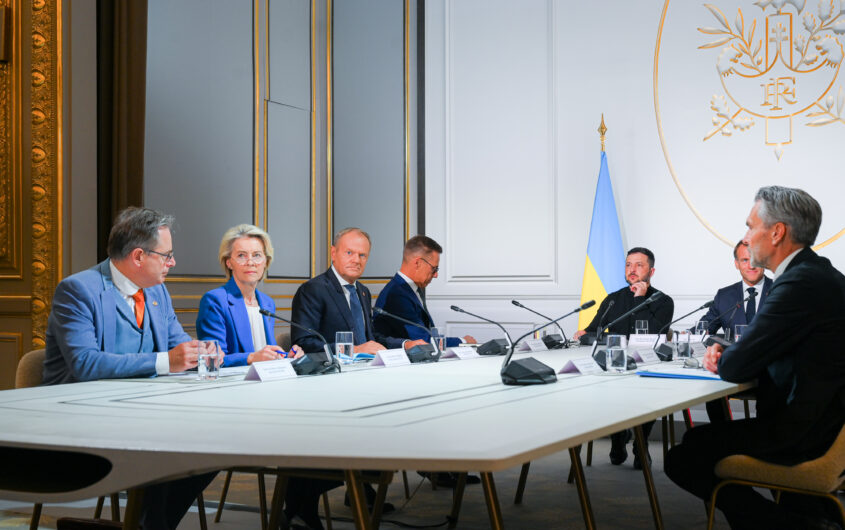
The initiative however gained a greater momentum after the election of President Trump. In March 2025, France and the UK announced a European “coalition of the willing” to support Ukraine’s sovereignty by upholding a ceasefire and deterring a renewed Russian aggression. More than thirty members of the coalition started to deliberate on security guarantees for Ukraine through a series of intense planning meetings. In September 2025, President Macron announced that twenty-six countries committed to contribute to the reassurance force in Ukraine needed to uphold peace. By spearheading the initiative, France and the UK are attempting to demonstrate to the White House that Europe is ready to take on leadership for security of the continent and, therefore, the United States should stay engaged.[12]
What tasks could a European deterrence force perform in Ukraine? While the operational parameters of a possible mission remain secret, it is safe to assume that European troops would contribute to a second line of defense behind the Ukrainian military, and would not be deployed at the frontline.[13] A more ambitious presence could include rapid reaction forces large enough—60-80,000 troops—to help the Ukrainian military to break through Russian defensive lines in case Russia violated a ceasefire.[14] The less ambitious mandate would be training and capacity-building of Ukrainian armed forces. European instructors could focus on combined arms operation and coordination between military units on a large scale.[15] This will be a step up compared to the current training programs that are bogged down with logistical challenges, as they are all organized outside of Ukraine. In addition, European troops could be engaged in policing Ukrainian skies, guarding critical infrastructure, or protecting the border with Belarus—all these measures would relieve Ukrainian military from some of the existing tasks allowing them to focus on more urgent ones closer to the frontline.
A major question is what the U.S. contribution to the reassurance force would be. The United States seemed open to providing Europeans with intelligence, surveillance, transport, logistical, and air support. Beyond American strategic enablers, there is a question whether the United States would get involved if European troops were attacked by Russians. Without clear understanding about the scope of the U.S. backstop, it is hard to elaborate clear rules of engagement for the European mission.[16] Another question is how long the deployment can be sustained. Financial constraints, shortage of military personnel, as well as growing domestic pressure from far-right political forces could all undermine the stability of a Franco-British led mission.[17] In addition, other European powers with significant military capabilities—Germany, Italy and Poland, in particular—are hesitant or dismissive about sending troops to Ukraine, which undermines the potential viability of the force. These political, logistical, and military challenges raise questions about feasibility of deploying the reassurance force in its most ambitious format.
Implications for security and defense in the Euro-Atlantic
The deterrence arrangement that will guarantee Ukraine’s security between now and Ukraine’s NATO accession is one that is primarily based on Ukraine’s own capabilities. Broadly speaking, this model of “deterrence by self-defense” implies that Ukraine is on the path of turning from a security consumer to a security provider. The signs of this trend are already visible today. In a reversal from the established patterns of military assistance, NATO members asked Ukraine for help with air defense when Russian drones penetrated Polish airspace in September 2025. Presenting his post-war vision, Ukraine’s president proposed that, granted permission, Ukrainian military forces could replace some U.S. contingents stationed in Europe. This makes it all the more important that no restrictions on Ukrainian armed forces and their integration with NATO militaries should be imposed as a part of a negotiated peace deal with Russia.
European military presence in Ukraine could meaningfully add to credible deterrence by denial against Russia. It would increase interdependency between Ukraine’s security and NATO security, serving as a tangible manifestation of Ukraine’s declared “irreversible path” to the Alliance. Placing forces in Ukraine would give partners “skin in the game,”[18] which was effectively missing in February 2022 when Russia launched its full-scale invasion. Furthermore, the planning process around the idea of military presence in Ukraine proved to be useful to build consensus and unity among Europeans. It allowed them to coordinate without the United States being involved, much less taking a leadership role, as has been common before. Beyond responding to Ukraine’s security needs, a European military mission would invalidate the Trump administration’s contemptuous view of Europe as a laggard who lacks “self-confidence” in dealing with Russia.
[1] Jeffrey W. Knopf, “Varieties of Assurance,” Journal of Strategic Studies 35, no. 3 (2012): 375-399.
[2] Keren Yarhi-Milo, Alexander Lanoszka, Zack Cooper, “To Arm or to Ally? The Patron’s Dilemma and the Strategic Logic of Arms Transfers and Alliances,” International Security 41, no. 2 (2016): 94.
[3] Brett Ashley Leeds, “Do alliances deter aggression? The influence of military alliances on the initiation of militarized interstate disputes,” American Journal of Political Science 47, no. 3 (2003): 427–439; Jesse C. Johnson, Brett Ashley Leeds, “Defense Pacts: A Prescription for Peace?”, Foreign Policy Analysis 7, no. 1 (2011): 45–65; Seung-Whan Choi, “Do Alliances Deter War?”, Foreign Policy Analysis 21, no. 4 (2025).
[4] Alexander Lanoszka and Jordan Becker, “The art of partial commitment: the politics of military assistance to Ukraine,” Post-Soviet Affairs 39, no. 3 (2023): 175.
[5] Thomas C Schelling, Arms and Influence (Yale University Press, 1967); Alexander L. George and Richard Smoke, “Deterrence and Foreign Policy,” World Politics 41, no. 2 (1989): 170–182.
[6] Glenn Snyder, Deterrence and defense: Toward a theory of national security (Princeton University Press, 1961).
[7] Amir Lupovici, “Deterrence by delivery of arms: NATO and the war in Ukraine,” Contemporary Security Policy 44, no. 4 (2023): 627.
[8] Alexander Vindman, The Folly of Realism : How the West Deceived Itself about Russia and Betrayed Ukraine. (New York: PublicAffairs, 2025).
[9] William Maley, “Ukraine, Afghanistan and the failure of deterrence,” Australian Journal of International Affairs 77, no. 4 (2023): 407-414; Bettina Renz, “Was the Russian Invasion of Ukraine a Failure of Western Deterrence?” Parameters 53, no. 4 (2023).
[10] Interview with a former U.S. official, October 20, 2025.
[11] Interviews with two Ukrainian officials, October 23 and November 18. 2025.
[12] Interview with a former U.S. official (1), November 4, 2025.
[13] Interview with a former U.S. Ambassador to Ukraine, October 13, 2025.
[14] Interview with a former U.S. official (2), November 4, 2025.
[15] Interview with a former U.S. official, October 23, 2025.
[16] Interview with a French diplomat, November 6, 2025.
[17] Interview with a former UK official, November 18, 2025.
[18] Brian Blankenship and Erik Lin-Greenberg, “Trivial Tripwires?: Military Capabilities and Alliance Reassurance,” Security Studies 31, no. 1 (2022): 97.
Supported by the DAAD with funds from the Federal Foreign Office (FF).