
Opposition 24 via Flickr
The AfD in the Run-up to the 2021 German National Election

Louise K. Davidson-Schmich
University of Miami
Louise K. Davidson-Schmich is Professor and Associate Chair of Political Science at the University of Miami, where she specializes in gender and politics and the political dynamics of long established democracies. She is the author of Gender, Crisis, and Leadership: Possibilities and Perils for Women Leaders (with Farida Jalalzai and Malliga Och; Oxford University Press, 2026). With Ross Campbell, she has also edited The 2021 German Federal Election: Negotiating a New Era (Palgrave, 2023) and the forthcoming volume The 2025 German Federal Election: A Polity Under Stress.
Davidson-Schmich is Editor of the journal German Politics and serves on the executive committee of the International Association for the Study of German Politics. She also sits on the editorial boards of Women, Politics and Policy and the European Journal of Politics and Gender. Her research has been supported by grants from the Alexander von Humboldt Foundation, Fulbright, and the National Science Foundation’s ADVANCE program. In addition, since 2020, she has served as a Board Member of the American Friends of the Alexander von Humboldt Foundation.
Down but Not Out
In 2017 the Alternative for Germany (AfD) entered the Bundestag, marking the first time in recent history a far-right populist party overcame the Federal Republic’s 5 percent threshold for parliamentary representation. The AfD enjoyed the support of 12.6 percent of voters. Since then, opinion polls have consistently found the party hovering around the 10 percent mark. It is now represented in all sixteen of Germany’s state legislatures, a feat matched only by the Social Democrats and the Christian Democrats – and only if the CDU/CSU is regarded as a single party. The AfD is currently poised to win a tenth of the vote in Baden-Württemberg and Rheinland-Pfalz’s March 14 state elections. In short, the Alternative for Germany appears here to stay, at least in the immediate aftermath of the September 26, 2021, national election. In this sense, Germany is not unusual among its neighbors. The AfD won 11 percent of the popular vote in the 2019 European Parliament (EP) elections just as Denmark’s far-right Dansk Folkeparti and the Dutch Forum voor Democratie did; similarly, Belgium’s Vlaams Belang gained 12 percent support in that contest while the French Rassemblement National won almost a quarter of the EP vote.
While the AfD’s Bundestag presence is unlikely to come to an end in September, there are several reasons to expect that 2021 may prove a more difficult election year for the party than 2017. In the latter contest, the AfD successfully portrayed itself as a populist outsider, rallying against elites and promising to bring change to the status quo. Today, the Alternative for Germany is the largest opposition party in the Bundestag and, as noted above, ensconced in all Länder parliaments as well. This status renders the AfD less able to don the mantle of a protest party. In 2017 almost a million and a half former non-voters turned out for the first time in support of the AfD, driving up voter turnout almost 4 percent over 2013. Many of these previous Nichtwähler may choose to stay home this year because the Alternative for Germany hasn’t been able to shake up politics to the degree it promised in the last election. Their strongest support comes from eastern Germany, where voter volatility is particularly high and citizens quick to defect from one party to another.
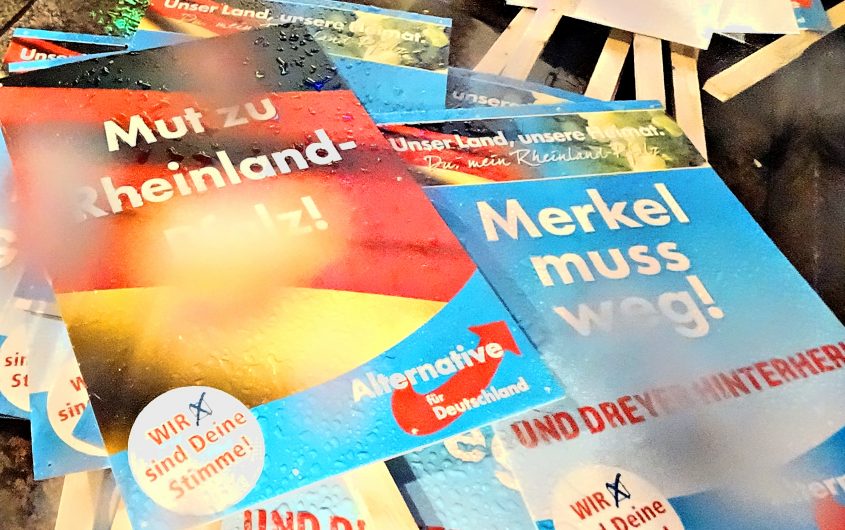
Another reason for the AfD’s success in the 2017 election was the salience of immigration issues after Angela Merkel embraced over a million asylum seekers trying to enter the country. Mainstream parties generally adopted a refugee-friendly stance or tried to downplay the issue, while the AfD enthusiastically espoused nationalist, anti-immigrant sentiments. The AfD was also able to capitalize on homophobic attitudes stirred up by Merkel’s decision to relax CDU/CSU party discipline and hold a Bundestag conscience vote on same-sex marriage in the last parliamentary meeting before the election. This backdrop allowed the AfD to run a vigorous and misogynistic anti-Merkel campaign led by Alexander Gauland, who threatened to “hunt down” the Chancellor and “take back” the country. While voter dissatisfaction with Eurozone bailouts – the focus of the far-right’s 2013 election campaign – was not enough to propel the party over the 5 percent threshold, sexist, homophobic, anti-immigrant rhetoric served the AfD well in 2017. This year, however, Merkel is no longer running, no hot button LGBT issues are on the table, and only about 5 percent of voters believe immigration is the most important problem facing Germany.
Today, the handling of the COVID-19 pandemic is the top issue of concern to citizens, but it is not entirely clear where the AfD stands on this key issue nor what position would be best for the far-right to adopt. On the one hand, party co-leader Jörg Meuthen has criticized the government’s handling of the pandemic stressing the slow rollout of the vaccine, speaking in favor of quickly immunizing the population. On the other hand, of all German parties, the AfD has the highest percentage of vaccine-skeptical followers and might profit from running instead on an anti-immunization platform. Moreover, between now and September’s election it is highly possible that vaccine- or COVID-related conspiracies (possibly driven by Russian disinformation as in 2017) may proliferate on social media; not knowing what form these conspiracies may take or how widely they may be believed by AfD supporters makes selecting the party’s best response to the pandemic difficult.
As it has been since its founding, the Alternative for Germany is currently riven by leadership struggles. In 2017 the party campaigned with a Spitzenduo – a team of lead candidates Alexander Gauland and Alice Weidel. Gauland is now over eighty and has given up his co-chair position in the AfD, serving as honorary chair only. Weidel, however, remains active and is hoping the Alternative for Germany will again run a co-ed team of lead candidates with herself at the helm. The agenda for the April party congress – planned as an in-person meeting in Dresden with hundreds of attendees – lists selection of a single co-chair. Weidel’s supporters are rumored to be planning a last-minute motion to propose co-chairs, likely Weidel and AfD Co-Chair Chrupalla. Others, including backers of the other Co-Chair Meuthen, a Member of the European Parliament, are hoping to postpone the decision of a lead candidate until the fall when they may be in a better position to see their preferred candidate, possibly Rüdiger Lucassen, chosen.
In addition to the current unknowns regarding the AfD’s corona policy stance and lead candidates, a further variable is the impact of the Office of Constitutional Protection’s decision to declare the entire party a Verdachtsfall. Their investigation found enough evidence to suspect the party of being a potential threat to German democracy. Party leaders and candidates can now be subjected to domestic surveillance such as phone tapping and email reading. While this news may not bother, or even mobilize, the AfD’s most extreme supporters it may prove a deterrent to more moderate voters. While the Alternative for Germany may not perform as well in 2021 as it did in 2017, the party will remain a force to be reckoned with after the election, again complicating the task of mainstream parties trying to form a governing coalition.