
Democrats Give Glimmer of Hope to Europe in First Debate: But Is It Enough?

Elizabeth Hotary
Communications Officer
Elizabeth Caruth Hotary is the Communications Officer at AGI, where she leads strategic communications, digital content management, and public engagement initiatives designed to elevate the Institute’s profile and expand its reach among policymakers, scholars, donors, and the public. She coordinates AGI’s research agenda; manages the editorial process from concept through distribution for AGI’s articles, publications, and digital content; produces AGI’s podcast, The Zeitgeist; and oversees the Institute’s media outreach efforts. She collaborates with leadership teams and external partners to ensure AGI produces high-quality, timely, and impactful content. She also manages relationships with AGI’s Board of Trustees and Non-Resident Fellows.
In over ten years at AGI, Ms. Hotary has contributed to research on populism and extremism, workforce education, and immigration and integration. She has co-led AGI study tours across the United States and Germany.
Before joining AGI, Ms. Hotary taught English at a secondary school in Herne, Germany, through the Fulbright Program. During her time as a Fulbrighter, she volunteered with the U.S. Consulate Düsseldorf’s MeetUS program, traveling to schools across North Rhine-Westphalia to engage secondary school students in discussions about the United States. She has previous experience at the Josef Korbel School of International Studies at the University of Denver and WorldDenver, a nonprofit global affairs organization.
Ms. Hotary received her MA from the Josef Korbel School of International Studies at the University of Denver, where she was a Marc Nathanson Fellow. She graduated magna cum laude from the University of Arkansas with degrees in International Relations, European Studies, and German. She is also an alumna of the Aspen Seminar for Young European Leaders, “Next-Gen Europe: Leading for Values.”
__
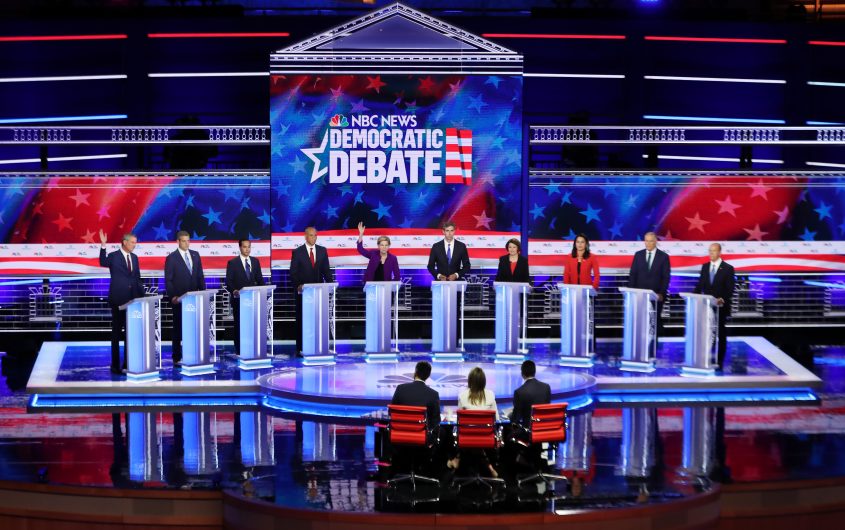
Since Donald Trump’s election in 2016, American transatlanticists have been repeating the phrase “the U.S. is more than just the president,” to their allies across the ocean. “Look to Congress,” “find partners at the state and local level,” and “focus on the issues rather than the personality”—all advice that has been given to Europeans for over two years as they try to make out newly hostile U.S. policies and a retraction from multilateral agreements like the Paris climate accords and the JCPOA. However, old habits die hard, and on June 26 and 27, the world got its first look at what a different executive could look like in the first Democratic primary debates of the 2020 election cycle.
Domestic issues of health care, the American economy, and immigration dominated the debate on both nights. However, discussion of issues like Iran and climate change displayed a marked contrast with the Trump Administration. None of the candidates disregarded the science of climate change and all prioritized it as a major threat to national (and international) security. In the first debate, all ten candidates were open to either renegotiating or rejoining the JCPOA. These two issues signal that the Democratic Party would be ready to reenter the multilateral world order and reengage with allies on issues crucial to global security. Trade and approaches to China—two other key opportunities for multilateral engagement, especially with Europe—were briefly mentioned, but candidates largely took the opportunity to focus on domestic issues such as struggling farmers and job losses rather than foreign policy implications.
When asked which relationship abroad they would reset first as president, five of the ten candidates mentioned Europe or NATO.
The clearest and strongest support for making up with Europe came on night two of the debates. Colorado senator Michael Bennet mentioned Germany by name, calling for rehabilitating our relationships with allies after President Trump’s constant attacks. When asked which relationship abroad they would reset first as president, five of the ten candidates mentioned Europe or NATO. Former vice president Joe Biden, Senator Kamala Harris, and Representative Eric Swalwell emphasized the importance of the NATO alliance particularly, with Biden calling it the “single most consequential alliance in the history of the United States,” and Swalwell declaring his first act in foreign policy would be “breaking up with Russia and making up with NATO.”
While Europe might rejoice at this early beacon of hope, everyone should prepare for a long slog to 2020. As of the first night of the Democratic debates, there were 383 days until the Democratic National Convention, where the challenger to Trump will officially be named, and 496 days until the November general election, where an administration change is not guaranteed. The opening round of Democratic primary debates gave Europe a preview of policy priorities of twenty potential new partners, but they should still consider how to engage the “partner” that currently sits in the White House.