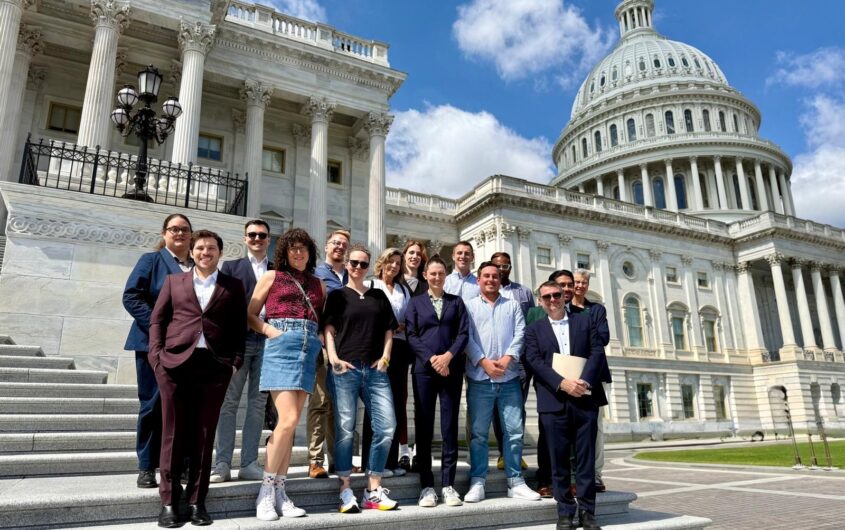
Building LGBTQ+ Communities in Germany and the United States: Past, Present, and Future
Year 3: Washington, District of Columbia, United States
LGBTQ+ individuals and their communities have been organizing to assert their rights for over a century, especially in Germany and the United States—two countries that were early pioneers and that have currently achieved more equality than many other places. But many challenges still persist, especially as a backlash to greater LGBTQ+ rights has been visible in both countries.
A comparative examination of the history, present, and future of LGBTQ+ rights will generate new understandings, leadership skills, and policy lessons for both countries and many others around the world. This AGI project fosters cross-cultural exchange with participants from diverse backgrounds by sharing personal testimonies, successes and failures, and best practices through week-long study tours in the United States and Germany.
Program Synopsis
Washington Blade
The Washington Blade is the oldest continuously operating LGBTQ+ newspaper in the United States. Renowned for its high-quality journalism, it is widely regarded as a newspaper of record—especially for the LGBTQ+ community. The name “Blade” originates from Victorian-era slang, where it referred to gay men.
The publication covers a broad range of topics, including local news, U.S. presidential administrations, foreign policy, and cultural affairs such as theater and dining. During the AIDS crisis of the 1980s, the Blade established itself as an indispensable source of information for a national audience, solidifying its reputation.
Throughout most of its history, the Washington Blade has remained locally owned. Although it was briefly part of a larger media conglomerate, it was later repurchased by individuals within the Washington LGBTQ+ community, restoring its independence and community-focused mission.
Over time, the Blade’s influence has extended beyond Washington, DC, and even the United States. It regularly collaborates with media outlets across Latin America and has reported extensively on LGBTQ+ refugees in Germany and throughout Europe, particularly following Russia’s invasion of Ukraine. These stories have highlighted the unique bureaucratic and social challenges LGBTQ+ refugees face.
The Blade distinguishes itself through a deeply community-centered approach to journalism. Rather than relying solely on official sources or major civil society organizations, its reporters often engage with individuals in their homes, businesses, and local community centers. This grassroots reporting style allows for more authentic, nuanced coverage of LGBTQ+ lives and issues.
During the second Trump administration, the Blade notably reported on the harmful effects of USAID budget cuts on LGBTQ+ communities abroad—cuts that had a tangible impact on access to critical relief and services. The Blade’s Washington, DC, coverage is particularly compelling due to the city’s lack of statehood, which limits its ability to push back against federal overreach. Under Trump, aggressive tactics to suppress dissent were especially pronounced in the District, where local authorities have fewer legal tools for resistance.
The Blade has reported on the complicated role of Mayor Muriel Bowser, who has had to navigate cooperation with the Trump administration while advocating for DC residents. Recent coverage has also highlighted how increased police checkpoints have adversely affected LGBTQ+-owned businesses, creating an atmosphere of heightened policing that deters patrons and threatens the vibrancy of LGBTQ+ nightlife and commerce.
While the Blade’s primary audience is the LGBTQ+ community, it also serves policymakers in Washington, DC. The publication aims to inform decision-makers in the hopes that its reporting can influence policies that more effectively support LGBTQ+ individuals and the broader community.
Georgetown University LGBTQ+ Resource Center
The Georgetown University LGBTQ Resource Center is housed within the Office of Student Equity & Inclusion (OSEI). Created in 2019, OSEI aims to strengthen collaboration and resource sharing across the university for first-generation students, women, students of color, students with disabilities, and LGBTQ+ students. The Resource Center follows OSEI’s model of three pillars—Integration, Collaboration, and Consultation—to ensure that minority students have access to the support they need to thrive at Georgetown. Importantly, OSEI has maintained its name, continuing to use the terms “Equity” and “Inclusion” despite broader political pressures, including the Trump administration’s discouragement of the term “Diversity, Equity, and Inclusion” among federally funded entities.
The LGBTQ+ Resource Center has been located in its newly remodeled space for two years. Its establishment was the result of sustained student advocacy and represented a milestone, becoming the first center of its kind on a Catholic Jesuit campus. As a Jesuit institution, Georgetown remains committed to a mission rooted in faith and a holistic vision of the individual, or cura personalis. At the same time, this religious identity poses certain institutional limitations, such as the inability to distribute contraceptives on campus.
In terms of student services, the LGBTQ+ Resource Center offers an extensive range of support for queer students, including mental health resources, community-building opportunities, and programs aligned with OSEI’s three guiding pillars. The space is intentionally designed to promote accessibility and safety, serving as an important entry point for students who may have concerns about navigating campus life. For transgender and non-binary students, the office provides comprehensive online resources and policies related to housing, campus safety, and name or gender-marker changes. The office also actively recognizes key milestones and moments for the LGBTQ+ community, including the annual commemoration of National Coming Out Day on October 11.
A significant strength of Georgetown’s support system for LGBTQ+ students is its robust and influential alumni network. LGBTQ+ alumni remain deeply engaged with the university, offering mentorship, advocacy, and visibility. Many serve as speakers at Georgetown’s Lavender Graduation, reinforcing a sense of continuity, community, and belonging for current students.
Out in National Security
Out in National Security (ONS) is a non-profit organization dedicated to supporting LGBTQ+ professionals working across the U.S. national security community. ONS was founded in 2018 on the premise that the Department of Defense is the largest employer of LGBTQ+ individuals in the United States and the Department of Veterans’ Affairs is the largest provider of healthcare to LGBTQ+ individuals. Recognizing that more than ten million Americans serve in national security roles and that queer employees often lacked representation, ONS functions as an umbrella organization connecting existing LGBTQ+ affinity groups across the military and federal agencies. Beyond supporting visibility, the organization promotes equitable hiring practices, advocates for protective policies, and works to reduce harm for LGBTQ+ personnel in high-stakes and often isolating work environments.
ONS also runs a fellowship program designed to cultivate the next generation of LGBTQ+ national security leaders. Through mentorship, professional development, and networking opportunities, the fellowship helps queer professionals navigate careers in fields that have historically been unwelcoming. In addition to career development, ONS engages in policy advocacy on a broad range of issues. Notable achievements include advancing access to IVF for same-sex couples, securing discharge upgrades that provide veterans with healthcare and housing benefits, and promoting transgender-inclusive healthcare for U.S. personnel serving abroad. These initiatives reflect ONS’s commitment to creating structural change alongside community support.
The organization’s work has become increasingly critical in the current political climate. Since 2017, federal protections for LGBTQ+ employees have been eroded, and resources such as agency affinity programs have largely disappeared. Supreme Court decisions have allowed thousands of transgender service members and federal employees to be dismissed, and harassment of queer personnel has intensified in agencies like the National Security Agency, Veterans Affairs, and State Department. ONS has stepped in to defend the rights of LGBTQ+ workers. For example, the organization has taken action to help transgender personnel continue to receive VA healthcare through the end of their service. In addition, the group monitors and responds to broader threats within the federal workforce, where political influence has at times compromised the integrity of national security agencies.
Through advocacy, mentorship, and community-building, ONS serves both as a lifeline for queer professionals and as a watchdog for policy and cultural changes affecting the national security workforce. Its work highlights the urgent need for inclusion and protection in a sector that relies on the expertise and dedication of millions of Americans. As federal policies shift and institutional knowledge faces erosion, ONS remains a crucial force for ensuring that LGBTQ+ voices are represented, supported, and empowered across national security.
U.S. Congressman Mark Takano
Congressman Mark Takano represents California’s 39th District and is one of twelve openly LGBTQ+ members currently serving in the U.S. Congress. Elected in 2012, he made history as the first openly gay person of color elected to Congress—a milestone that came following California’s Proposition 8, which had temporarily eliminated the right of same-sex couples to marry in the state.
Throughout the 2010s, public opinion and legal protections for LGBTQ+ Americans evolved significantly. The landmark 2015 Supreme Court ruling in Obergefell v. Hodges legalized same-sex marriage nationwide, shifting the strategy of progressive lawmakers from advocacy for new rights to defending existing ones.
In 2022, Congressman Takano was among the 188 co-sponsors of the Respect for Marriage Act, a historic piece of legislation that reaffirmed federal protections for same-sex and interracial marriages. The Act marked a significant legislative victory and was the first federal bill addressing marriage equality to successfully pass through Congress.
However, the struggle for LGBTQ+ rights continues, often in more defensive terms. Rather than only pushing for expanded protections, progressive lawmakers face growing pressure to resist attempts to roll back established rights. Conservative lawmakers have increasingly introduced anti-LGBTQ+ amendments across a range of issues, many targeting transgender individuals in particular.
While many of the most extreme proposals do not make it into final legislation, there are notable exceptions. For example, the 2024 National Defense Authorization Act (NDAA) included a controversial provision banning gender-affirming medical care for transgender minors in military families. To the surprise of LGBTQ+ advocates, this provision garnered support from ten Democratic members of Congress, underscoring the challenges faced by progressive legislators navigating politically competitive districts and thin electoral margins.
The issue of transgender rights has become a focal point of national political division. Conservative efforts to restrict gender-affirming care, limit inclusive education, and roll back civil protections have proven politically effective in some regions, threatening to undo years of progress. Progressive federal lawmakers continue to play a vital role in both resisting these rollbacks and advocating for an inclusive vision of American society where LGBTQ+ individuals are protected and respected under the law.
U.S. Congressional Equality Caucus
The Congressional Equality Caucus is a member-structured organization within the U.S. House of Representatives dedicated to advancing LGBTQ+ rights and equality. Funded through dues paid by member offices from annual budgets, the Caucus serves as a vital resource for both members of Congress and their staff. With membership open to all U.S. Representatives in Congress, currently, only Democratic members benefit from the Caucus’s services.
The Caucus connects Representatives across the political spectrum who prioritize LGBTQ+ issues and provides their offices with tools and support to better serve LGBTQ+ constituents. Its staff offer a range of services, including organizing educational briefings, assisting with strategic messaging on legislation and emerging issues, and supporting offices in navigating complex conversations with constituents.
Operating under a baseline non-discrimination policy, the Caucus recognizes that effective advocacy may require tailored approaches. For members representing competitive or moderate districts, the Caucus works to develop inclusive messaging that resonates with diverse constituencies, while still advancing core values of equality and inclusion.
In addition to advocacy, the Equality Caucus plays a critical role in ensuring that legislation and amendments across a wide range of policy areas are inclusive of LGBTQ+ individuals. They review legislation moving through Congress and advise members as well as their staff on the potential impacts on the LGBTQ+ community. Their review of legislation across all policy portfolios allows the Caucus to advise lawmakers on areas where legislation can be improved to better support LGBTQ+ individuals.
Metro Police Department LGBTLU Office, Gary Thompson
Established in the early 2000s, the Metropolitan Police Department’s Lesbian, Gay, Bisexual and Transgender Liaison Unit (LGBTLU) was created in response to widespread underreporting of crimes in LGBTQ+ communities in DC, where victims often feared approaching police. The department’s leadership, recognizing this gap, formalized the office that was originally called the Gay and Lesbian Liaison Unit (GLU), to provide direct lines of communication via email and phone and to ensure that members of marginalized groups could access necessary resources. The importance of these units is to ensure the safety and visibility of the LGBTQ+ community members. Today, the unit includes around twenty-five officers drawn from seven police districts and coordinates with liaison counterparts for Deaf and Hard of Hearing, Latina, Asian, and faith communities. Core functions include recruitment and in-service instruction on respectful engagement, pronoun use, and queer neighborhood context; routine follow-ups with victims of targeted violence; and referrals to the support network in DC such as Honoring Individual Power & Strength (HIPS), Sexual Minority Youth Assistance League or (SMYAL), and the Wanda Alston Foundation. The unit meets monthly with the Mayor’s Office and partner agencies to review violent-crime trends and case status.
Reported anti-LGBTQ crime in DC is described as steady over recent years, with notable serious cases including a transgender homicide in July that led to a recent arrest. Broader city crime spikes did not produce a clear parallel surge in anti-LGBTQ incidents. Trust is sensitive to optics: recent “federalization” and visible joint patrols with federal partners under the Trump administration have raised fear in parts of the community. MPD policy, reinforced by a recent mayoral directive, is not to cooperate with ICE in civil immigration enforcement; officers may see an ICE notice during an arrest query but are not tasked (or obligated) to pursue status.
The department invests heavily in crisis response. Crisis Intervention Training (CIT) is standard, 988, the suicide prevention hotline, is integrated into practice, and MPD co-responds with the Department of Behavioral Health. Fairfax County’s mobile crisis unit was cited as a regional model. The unit also conducts public awareness and prevention outreach, including Pride planning and festival presence, which has improved cooperation after earlier tensions. Compared with many jurisdictions in Virginia and elsewhere, DC’s liaison structure is more formalized and comprehensive.
LGBTQ+ Victory Institute
LGBTQ+ Victory Institute is a Washington, DC-based nonprofit dedicated to increasing LGBTQ+ representation in elected and appointed government positions across the United States. Rather than focusing on specific policy issues, the Institute’s mission is centered on ensuring that LGBTQ+ individuals are visible and represented at all levels of government—local, state, and federal.
With over 500,000 elected offices in the United States—of which only 1 percent are federal, 3.6 percent are state, and 96 percent are local—the Institute has set a long-term goal of helping 46,000 LGBTQ+ individuals run for and win office. This number represents proportional representation relative to the LGBTQ+ population in the United States. Yet, significant challenges remain. In 2023, 75 percent of elections across the country went uncontested or had no candidates, highlighting the Institute’s mission to expand the network of diverse political leaders running for elected office.
The Victory Institute offers a range of nonpartisan programs designed to break down systemic barriers that have historically excluded LGBTQ+ individuals from political life. These initiatives include Congressional internships and fellowships, in partnership with the Congressional LGBTQ+ Equality Caucus, to provide early-career experience on Capitol Hill.
Their programs also feature candidate training programs, such as the “Empowerment Fellowship” and “Women Out to Win Fellowship,” which prepare LGBTQ+ individuals—especially women—to run successful campaigns. The Institute also places an emphasis on increasing the number of women running for office. While women are statistically less likely to run than men, those who do are often more successful in winning their races. Victory Institute programs are designed to address this gap by building confidence, campaign skills, and support networks.
The International LGBTQ+ Leaders Conference is an annual event that convenes over 100 participants from around the globe to share strategies, build networks, and inspire leadership. However, the Institute has faced significant obstacles in recent years. Since the beginning of the second Trump administration, the organization has lost critical connections with the executive branch that were previously used to elevate LGBTQ+ candidates. In addition, Trump-era policies have disrupted the Institute’s ability to work with international partners, limiting the scope of its International Leaders Conference and other global initiatives.
Despite these challenges, the LGBTQ+ Victory Institute remains committed to increasing LGBTQ+ visibility and participation in politics to build a more inclusive democracy that reflects the diversity of the American people.
Washington, DC, Mayor’s Office for LGBTQ+ Affairs
The Washington, DC, Mayor’s Office for LGBTQ+ Affairs is an executive office housed within the Mayor’s Office of Community Affairs, which includes several teams focused on civic engagement with diverse communities in Washington, DC. The LGBTQ+ Affairs team, made up of nine staff members, is dedicated to ensuring inclusion, equity, and access for LGBTQ+ individuals across the city through community engagement and the promotion of culturally competent services.
Since 2021, the Office has secured an 8,300 percent increase in funding. This growth includes an operating amount of 6.3 million dollars in annual giving and program funding in fiscal year 2025. The Office passes a balanced budget each year and receives most of its funding from local tax revenue. The Mayor’s Office for LGBTQ+ Affairs plays a vital role in the District, particularly given that Washington is home to one of the largest LGBTQ+ populations in the country per capita. An estimated 14 to 15 percent of the city’s residents identify as LGBTQ+, giving the Office significant responsibility in supporting and advocating for the community.
A large portion of the Office’s work focuses on housing support for LGBTQ+ residents. The team currently provides 110 housing vouchers and assists more than 100 individuals in securing and maintaining stable housing. The Office also plays an important role in public health, monitoring and responding to outbreaks of sexually transmitted infections in DC’s wards, particularly in wards 7 and 8, where residents may face barriers to accessing care. The Office has also been instrumental in reducing HIV rates in the District through public education campaigns that promote safer sex and the use of preventative medication. The Office has tracked these outbreaks and utilizes its collected data to execute targeted healthcare initiatives.
In 2025, the Office’s community engagement efforts reached a new level when it organized and executed World Pride in Washington, DC. The event generated an estimated $310 million in positive economic impact and drew 1.2 million attendees over the summer. More than 700 people worked to support and execute World Pride, helping ensure the event’s success across the city. As part of this effort, the Office distributed 1.4 million dollars in community grants, allowing smaller organizations within Washington’s queer community to participate in and benefit from World Pride activities.
Through its work in housing, healthcare, and community engagement, the Washington, DC Mayor’s Office for LGBTQ+ Affairs continues to strengthen equity, access, and inclusion for LGBTQ+ residents and ensure that the District remains a leader in supporting and celebrating its diverse communities.
Whitman-Walker Health
Whitman-Walker Health has been providing healthcare services in Washington, DC, for nearly fifty years. Originating along the 14th Street corridor, the clinic initially focused on serving lesbian, gay, and bisexual individuals, as well as people struggling with alcoholism. Many of its early original properties along 14th Street for its operations were donated to the clinic by gay men who passed away without family to inherit their homes.
When the HIV/AIDS crisis emerged in the United States in 1982, the clinic became a frontline care provider for those affected—particularly LGBTQ+ individuals—cementing its place as a vital institution in public health. Since 1987, Whitman-Walker has also played a key role in medical research, earning a global reputation for its expertise in healthcare for LGBTQ+ communities. It has particularly been a key institutional resource for healthcare providers across the country and the world in providing trans individuals with better care.
Today, Whitman-Walker is a federally qualified health center (FQHC), receiving government funding and accepting subsidized insurance plans. Its $140 million annual budget is supported by a mix of federal grants (25 percent), insurance reimbursements (35 percent), and revenue from its in-house pharmacy. The clinic employs around 300 staff members and serves approximately 12,000 patients, with its reach expanding steadily due to its reputation for high-quality, inclusive care.
Located in one of the most diverse regions in the United States, Whitman-Walker serves a significant number of LGBTQ+ immigrants. However, restrictive immigration policies under the current presidential administration have put many of these patients—particularly transgender individuals—at risk of losing health coverage and access to essential care.
Human Rights Campaign
Human Rights Campaign (HRC) is the largest advocacy group in the United States dedicated to advancing the rights of the LGBTQ+ community. With a staff of around 200 people, HRC operates through a 501(c)(3) foundation for educational and community-focused work, a 501(c)(4) lobbying arm, and electoral entities active across the country. The organization’s mission is to fight for a more inclusive future, addressing progressive issues while demonstrating that these values are widely supported by Americans. HRC engages with its 3.6 million members—who contribute an average of $5 per month—by providing guidance on advocacy and encouraging participation in grassroots campaigns and local initiatives.
HRC’s advocacy strategies include lobbying Congress across the political spectrum, engaging in community education, and participating in roughly 300 Pride events each year. The organization also hosts an annual dinner with 2,500 attendees and utilizes 32 steering communities nationwide to organize local efforts. Over time, HRC has adapted its internal decision-making processes to better understand intersectionality and ensure that its leadership reflects the diversity of the communities it serves. Staff levels fluctuate around election cycles, reflecting the organization’s dual focus on both policy advocacy and electoral engagement.
One of HRC’s flagship initiatives is the 1 Million Stories campaign, which encourages individuals to share their personal experiences to raise awareness of how policies affect real lives. The campaign emphasizes the dangers of authoritarianism and the abuse of power, highlighting how division and disconnection within communities can be exploited. HRC’s work demonstrates that public opinion can change over time, as evidenced by the eventual reversal of setbacks like California’s Proposition 8, which banned same-sex marriage in 2008. By connecting personal stories to broader policy issues, HRC seeks to foster trust and strengthen the impact of advocacy efforts.
Despite its successes, HRC faces challenges in communications and public trust. Polling indicates that while many Americans support LGBTQ+ rights, there is a need for messaging that better aligns with fundamental American values such as freedom, fairness, and equality. By leveraging storytelling, emphasizing shared values, and strengthening grassroots engagement through local steering communities, HRC aims to broaden its reach, influence public opinion, and continue shaping legislation in a more inclusive direction.
GenOut
GenOut is one of only six LGBTQ+ youth choruses in the United States, and over its twelve seasons it has grown into a vibrant community of more than 150 young people representing eleven schools. Supported financially by the Gay Men’s Chorus of Washington, the ensemble brings together singers ages 13 to 18 to amplify LGBTQ+ youth voices and build unity through the shared experience of music. The group meets once a week for rehearsals, fostering both musical growth and a strong sense of community.
A non-audition ensemble, GenOut welcomes all who are committed to using their voices to uplift social justice. They have performed at distinguished venues such as the Kennedy Center, the Library of Congress, and the National Cathedral. Each year they present Youth Invasion, a dynamic program that showcases the full collection of pieces prepared throughout the season, featured prominently at their annual holiday concert.
Visiting the AGI office, GenOut had the opportunity to not only meet with participants of the program, but also showcase their talent, performing numerous pieces from their repertoire. GenOut and program participants also discussed key issues for LGBTQ+ youth and how performing arts can help provide a safe, positive-reinforcing space for young queer people.
Gay Men’s Chorus of Washington
The Gay Men’s Chorus of Washington (GMCW) is one of the largest LGBTQ+ musical groups in the United States, with more than 300 members—240 of whom are active singers. Their annual holiday show is the ensemble’s largest event, showcasing their repertoire and drawing audiences from across the region. Beyond this signature performance, GMCW regularly appears at important community events in Washington, DC, and around the country, notably at Black History Month celebrations and Pride Month festivities. Their annual concerts are held at the historic Lincoln Theater on U Street, in the heart of Washington, DC.
Gay Men’s Choruses in the United States began in the 1970s during the second wave of feminism. Women’s and lesbian choirs were often the trailblazers, opening the door for the creation of gay men’s ensembles. In 1978, John Reed Sims founded the first gay men’s chorus in San Francisco, which gave its inaugural performance at the funeral of Harvey Milk, the first openly gay man elected to political office in the United States. The San Francisco Gay Men’s Chorus’ performance profoundly moved a Washington resident named Marsha Pearson, who went on to establish the Gay Men’s Chorus of Washington through grassroots community organizing. Following this, the GMCW gave its first performance in 1981 and by 1983, there were eleven gay choruses nationwide.
GMCW’s history also reflects the challenges endured by LGBTQ+ communities. During the AIDS epidemic, the Chorus lost 100 members to the disease. Later, under the “Don’t Ask, Don’t Tell” policy, many active-duty military members within the Chorus were forced to hide their identities and avoid photos or program listings. The repeal of this policy marked a turning point in GMCW’s story, allowing all members to perform openly—without fear, restriction, or the threat of discharge.
This project is supported by the Transatlantic Program of the Federal Republic of Germany, funded by the European Recovery Program (ERP) of the Federal Ministry for Economic Affairs and Energy (BMWE).