
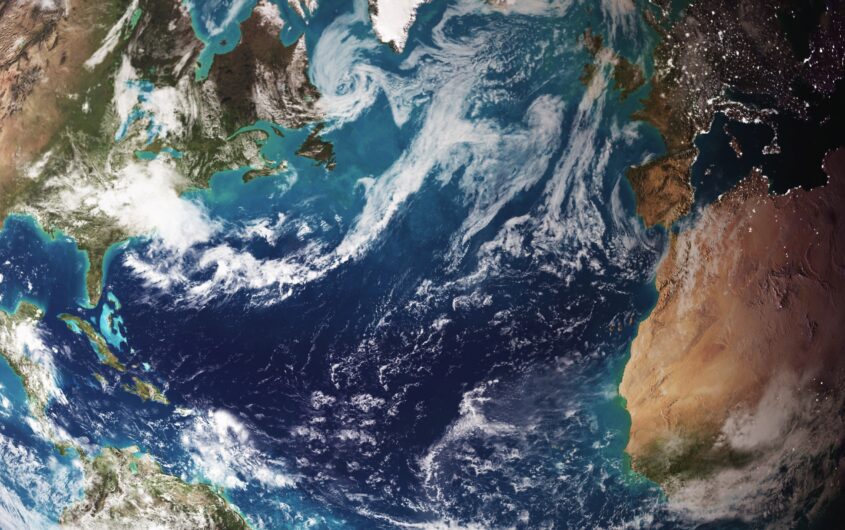
NASA via Rawpixel
The Transatlantic Relationship and the Future Global Trading System

Peter S. Rashish
Vice President; Director, Geoeconomics Program
Peter S. Rashish, who counts over 30 years of experience counseling corporations, think tanks, foundations, and international organizations on transatlantic trade and economic strategy, is Vice President and Director of the Geoeconomics Program at AICGS. He also writes The Wider Atlantic blog.
Mr. Rashish has served as Vice President for Europe and Eurasia at the U.S. Chamber of Commerce, where he spearheaded the Chamber’s advocacy ahead of the launch of the Transatlantic Trade and Investment Partnership. Previously, Mr. Rashish was a Senior Advisor for Europe at McLarty Associates, Executive Vice President of the European Institute, and a staff member and consultant at the International Energy Agency, the World Bank, UN Trade and Development, the Atlantic Council, the Bertelsmann Foundation, and the German Marshall Fund.
Mr. Rashish has testified before the House Financial Services Subcommittee on International Monetary Policy and Trade and the House Foreign Affairs Subcommittee on Europe and Eurasia and has advised three U.S. presidential campaigns. He has been a featured speaker at the Munich Security Conference, the Aspen Ideas Festival, and the European Forum Alpbach and is a member of the Board of Directors of the Jean Monnet Institute in Paris and a Senior Advisor to the European Policy Centre in Brussels. His commentaries have been published in The New York Times, the Financial Times, The Wall Street Journal, Foreign Policy, and The National Interest, and he has appeared on PBS, CNBC, CNN, NPR, and the BBC.
He earned a BA from Harvard College and an MPhil in international relations from Oxford University. He speaks French, German, Italian, and Spanish.
Today’s challenges to the global trading system are exacerbating a dynamic that is at least a decade old. Since the failure of the Doha Round of multilateral trade negotiations to make progress at the World Trade Organization’s biennial meeting in December 2015 in Nairobi, Kenya, the balance of economic power in the world has continued to shift. China, no longer the developing country it was when it joined the WTO in 2001, is now a large and globally competitive manufacturing economy, while countries like India and Brazil have also gained in relative influence. The period of globalization (or hyperglobalization) that defined the roughly twenty-five years between the fall of the Berlin Wall and the Doha Round’s failure in 2015 has given way to a new “post-idealist” era that is characterized by a weaker multilateral system, greater skepticism among voters toward trade liberalization, and an increasing use of trade policy tools to achieve economic security.
In this report, Peter Rashish examines whether current institutions like the World Trade Organization can adapt to this shift or if new institutions and rules will be needed—and what role the transatlantic relationship will have in shaping the global trading system of the future. While close cooperation between the United States and the European Union has been the key driver of innovation in the trading system, U.S. and EU trade policies today are defined as much by their differences as their commonalities. Whether the global trading system undergoes a transition, mutation, or rupture in the next decade will depend to a considerable degree on the capacity of the transatlantic relationship to exert joint agency in a more diverse and competitive world.
This publication is supported by Roland Berger and the AGI Geoeconomics Program.