
The U.S. National Archives via Picryl
Deterrence Under Uncertainty

Marlon Demandt
Halle Foundation/AGI Intern
Marlon Demandt is a fall 2025 Halle Foundation Intern at the American-German Institute and a second-year graduate student in International Affairs at George Washington University’s Elliott School, where he is a Fulbright and DAAD Scholar. His concentration focuses on the intersection of technology and international affairs, with a regional emphasis on China. Originally from Heidelberg and raised in Munich, he earned a Bachelor of Science in Political Science with a focus on technology, data science, and economics from the Technical University of Munich (TUM). During his undergraduate studies, he completed exchange semesters at Sciences Po in France and Seoul National University in South Korea and was selected as a scholar of the LSE German Symposium.
Alongside his studies, Marlon has gained professional experience in finance, consulting, and public policy. He has held roles at Alvarez & Marsal, Miller & Meier Consulting, KPMG, Fortlane Partners, and Possible Digital. He was also part of the founding team of a German IoT startup, interned with a Member of the Bundestag, and recently served as a research assistant to Professor Hope M. Harrison at GWU’s Institute for European, Russian, and Eurasian Studies.
His research interests include the evolution of Germany’s security landscape vis-à-vis Russia amid shifting U.S. foreign policy, as well as the role of technology in geopolitics within the triangular dynamic of Sino-American, transatlantic, and German-Chinese relations.
Europe’s Long-Range Strike Dilemma
A Familiar Dilemma in a New Strategic Era
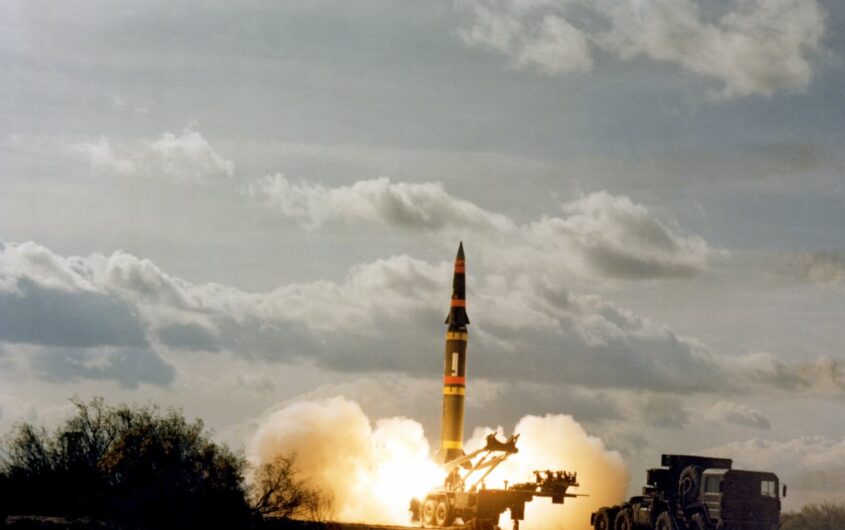
The American security umbrella has leaks, the chancellor says. At first glance, this line could easily be mistaken for a recent warning by Chancellor Friedrich Merz in response to yet another destabilizing statement from President Trump about NATO. But the words are nearly half a century old. They appeared in a New York Times article recounting a speech by another German chancellor: Helmut Schmidt. In his address at the International Institute for Strategic Studies (IISS) in October 1977, Schmidt warned that Europe could no longer rely unquestioningly on American protection. He argued that superpower “parity” obscured Europe’s specific vulnerability to Soviet missiles and risked decoupling European security from U.S. strategic deterrence. To close this “escalation gap,” Schmidt urged the deployment of U.S. Pershing II and cruise missiles in Europe—not as a rejection of the American umbrella, but as a means to restore its credibility at the European theater level. At the time, this was likely the only viable option—but it also entrenched a pattern of reliance on U.S.-provided strike capabilities that would outlast the Cold War.
Today, Chancellor Merz faces a strategic dilemma strikingly similar to Schmidt’s in the 1970s. Once again, the credibility of the U.S. deterrent is in doubt, weakened by President Trump’s questioning of NATO commitments, unilateral Ukraine “peace plans” announced without allied consultation, a reported breakdown in Pentagon-Bundeswehr communication, and culminating in a devastating National Security Strategy that deprioritizes Europe while conspicuously sparing key adversaries. These doubts have hardened into concrete alliance tensions as the Trump administration escalated demands over Greenland, prompting warnings from European leaders that coercive action against a NATO ally would threaten the alliance’s very foundations. At the same time, Russia has shifted from defensive nuclear deterrence toward offensive nuclear intimidation with doctrinal changes, the forward deployment of tactical nuclear weapons in Belarus, and expanding missile production, culminating most recently in the use of the nuclear-capable Oreshnik hypersonic missile against western Ukraine on a trajectory oriented toward Poland. Germany and its European allies are thus forced to confront deterrence under conditions of both American uncertainty and deliberate Russian coercion.
As in the late 1970s, Merz may again have little choice in the short term but to rely on U.S. long-range strike systems to close an immediate deterrence gap. The strategic challenge is to ensure that this necessary reliance does not harden into another generation of dependency. Germany therefore has the strategic obligation to lead a European joint effort to build sovereign long-range strike capability—a critical component of conventional deterrence—and strengthen deterrence by punishment.[1]
“Sovereign” capability has two distinct dimensions. The first is operational sovereignty: European command authority over planning and employment. The second is sustainment sovereignty: the ability to stockpile and replenish munitions without a single external supplier becoming a political chokepoint in wartime. This distinction matters because a capability can be operationally sovereign while still creating dependency risks through foreign manufacture and resupply.
In the short term, available U.S. systems will be indispensable to closing Europe’s immediate deterrence gap. In the medium and long term, however, continued reliance on U.S.-controlled strike capabilities risks locking Europe into a new cycle of dependency under conditions of increasing political uncertainty in Washington. Germany must pursue a dual-track approach: rapidly fielding available U.S. capabilities to close the immediate deterrence gap, while building a sovereign European long-range strike capacity that can be produced and replenished at scale in Europe. The objective is not strict autonomy from the United States but credible deterrence that is not contingent on U.S. release authority, U.S. political decision-making, or U.S. resupply in a prolonged crisis.
The Umbrella is Leaking
The United States has been the central guarantor of European security through both conventional and nuclear deterrence since the end of World War II, and Germany hosts a substantial portion of that presence still. In the domain of conventional missiles, the U.S. Army in Wiesbaden is being prepared to support deployments of ground-launched long-range fires beginning in 2026, including conventionally armed Tomahawk cruise missiles, land-adapted SM-6s, and, eventually, Dark Eagle hypersonic systems. On the nuclear side, U.S. B-61 gravity bombs remain forward deployed at Büchel Air Base in western Germany under exclusive U.S. custody and release authority. However, this arrangement functions primarily as a political signal of deterrence, designed to reinforce extended deterrence and alliance commitment rather than to provide an early-use warfighting option; its credibility ultimately derives from the U.S. commitment to NATO and its willingness to act under Article 5.
Continued reliance on U.S.-controlled strike capabilities risks locking Europe into a new cycle of dependency under conditions of increasing political uncertainty.
That credibility has increasingly been undermined by the Commander-in-Chief, forcing both allies and adversaries to doubt whether he would truly risk Mar-a-Lago for Berlin, let alone Tallinn. This political uncertainty compounds existing military imbalances. Following the U.S. withdrawal from the INF Treaty in 2019 as a result of Russian noncompliance, Russia rapidly expanded its inventory of ground-launched cruise and ballistic missiles in the 500 to 2,500 kilometer range, while America fielded no comparable systems in Europe until the recent decision to prepare deployments. The result is a dual credibility gap: Europe lacks sufficient long-range conventional strike capacity to hold Russian targets at risk, while doubts about U.S. political resolve weaken the deterrent effect of the forces that are already present.
In other words, while forward U.S. presence still matters, deterrence credibility ultimately hinges on political resolve. If U.S. commitments become conditional, Europe must be able to plan, sustain, and employ long-range strike capabilities under European control.
Russia’s Expanding Long-Range Strike Arsenal
Despite the war in Ukraine tying down significant Russian forces, Bundeswehr assessments indicate that Russia retains sufficient conventional capacity to credibly threaten NATO territory. Crucially, Moscow is not depleting its long-range strike arsenal. Since 2022, Russia has sustained an exceptionally high tempo of ballistic and cruise missile strikes as well as drone attacks in Ukraine while simultaneously expanding production. Between 2022 and 2024, Russia launched more than 11,000 missiles and drones, yet data from the Center for Strategic and International Studies’ Russian Firepower Tracker shows a continued upward trend in monthly launches, indicating that production has not reached saturation.
While precise figures remain uncertain, Western analysts agree that Russian long-range missile production has increased markedly since late 2023, with output of key cruise and ballistic systems rising by roughly 25 percent year-over-year. Ukrainian estimates suggest that annual production now exceeds usage for several missile categories, allowing Russia to both replenish stocks and expand inventories. Analysts such as Fabian Hoffmann support these assessments, pointing to observable industrial expansion as confirmation of this trend. The implication is clear: Russia is not merely sustaining its war effort in Ukraine but rebuilding and expanding long-range strike capacity for potential contingencies beyond it, at a moment when Europe faces growing uncertainty about U.S. political resolve and persistent capability shortfalls.
Europe’s Empty Quiver
Crucially, this shortfall is not the result of insufficient resources. European NATO members spent roughly $454 billion on defense in 2024, with Germany alone accounting for $88.5 billion. Europe is collectively the world’s second-largest defense spender, and at that level of investment, one might expect a robust, and potentially European-manufactured, long-range strike capability. Yet despite serious money, Europe’s long-range strike posture remains weak.
While Europe fields several advanced missile systems, none exist in the quantity, range, or readiness needed to match Russia. Air-launched European systems like Taurus, Storm Shadow/SCALP, and the Joint Strike Missile reach 500–600 km, but their production lines have been largely dormant for years. New variants—such as Taurus Neo or JSM for the F-35—remain in development and will not enter service before 2030. Germany’s current operational Taurus stockpile is small (around 150 missiles), with no restart of the current variant and only limited Neo production expected (roughly 40–50 per year). Efforts to replace the U.S.-made Taurus turbofan engine—subject to U.S. export restrictions, including in the case of transfers to Ukraine—with German or Japanese alternatives to improve sovereign control further complicate timelines. Storm Shadow/SCALP production has resumed after a fifteen-year pause but remains far below what a major conflict would require, especially after transfers to Ukraine depleted inventories. Compounding the issue, Europe faces supply-chain vulnerabilities, including dependence on Chinese rare-earth and critical metals, which may further restrict production capacity.
Although some allies, like the Netherlands, have purchased new long-range systems, Europe’s major powers have not. As Fabian Hoffmann notes, the long-range arsenals of France, Germany, Italy, and the UK have effectively stagnated since the early 2000s. Most other European missiles—such as Kongsberg’s NSM—are short-range maritime weapons, and only the UK fields true long-range land-attack missiles (U.S. Tomahawks aboard its Astute-class submarines), but in very small numbers. Beyond limited British and French capabilities, Europe has no modern ground-launched system above 500 km. The only such systems expected on European soil before 2030 are U.S.-owned and U.S.-controlled deployments.
Some medium-term improvements are underway, including the fielding of longer-range air-launched munitions (>930 km) such as the Lockheed Martin-made JASSM-ER by Poland and Germany around 2027. These systems strengthen operational sovereignty because they fall under national command authority, but they do not fully resolve sustainment sovereignty, as replenishment depends on a U.S. production base. Other projects that would meet the sovereignty definition, such as the German-Norwegian 3SM Tyrfing, exist but remain long-term efforts not expected before 2035.
Industrial policy and national timelines are driving capability development more than a shared strategic concept.
This gap was meant to be addressed through ELSA, the European Long-Range Strike Approach, launched after the July 2024 NATO summit by France, Germany, Italy, and Poland, later joined by Sweden and the UK. ELSA was intended to pool national efforts into a coherent European framework. However, several participating states have already moved ahead with national or bilateral missile programs, while others continue to procure U.S. systems in parallel. Formally, ELSA still exists, but it has not become the coordinating mechanism it was intended to be.
The initiative remains in a conceptual phase, and the more optimistic deployment timelines discussed in summer 2024 have since faded from discussion, leaving no clear schedule for fielding a joint system. No common design has been selected, and progress has been slow. Instead, Europe is witnessing a growing fragmentation of long-range strike development: Germany is relying on U.S. fires in the near term while investing in the Taurus NEO and 3SM Tyrfing for the mid-2030s; France is pursuing national ballistic missile projects; Sweden has launched compressed national development efforts; and the UK has announced separate cruise and ballistic missile concepts. This proliferation of parallel projects underscores a central problem: industrial policy and national timelines are driving capability development more than a shared strategic concept, limiting Europe’s ability to rapidly produce, replenish, and sustain long-range strike capabilities at scale. Success for ELSA should not be measured by the delivery of a single missile system but by the creation of a European production, stockpiling, and replenishment ecosystem capable of sustaining long-range strike at scale in a prolonged crisis.
Breaking the Industrial Policy Trap
This dynamic lies at the heart of Europe’s long-range strike deficit. It is the predictable result of historical dependence and political-economic choices. When Helmut Schmidt confronted the missile gap of the late 1970s, Germany lacked both the industrial capacity and the political space to build its own long-range conventional systems. As a non-nuclear weapons state, delegating the problem to U.S. Pershing II and cruise missiles was unavoidable—but it cemented a dependency that outlived the Cold War.
Once Washington filled the gap, European governments largely abandoned deep-precision strike development. Long-range investment largely ceased after the 1990s, leaving Europe structurally reliant on U.S. conventional platforms, supply chains, and political decisions. Today, history risks repeating itself in a more dangerous form. The availability of advanced U.S. systems—from Tomahawks to future hypersonics—again incentivizes short-term procurement over long-term sovereignty, even as U.S. political resolve becomes increasingly uncertain.
The core obstacle is not funding but European division and industrial-policy primacy over strategy—the prevailing philosophy that defense industry investments must primarily benefit domestic economies. ELSA was conceived to overcome this problem, yet it has already fractured into parallel national and bilateral projects driven by domestic timelines and industrial comfort rather than shared operational requirements. The result is not European sovereignty but a proliferation of uncoordinated systems that potentially struggle to deliver scale, speed, or sustainment. What is at stake is not just revenue but Europe’s sovereign capacity: the supply chains, engineering expertise, and institutional knowledge that make independent weapons development possible.
What remains of ELSA is increasingly shaped less by battlefield requirements than by industrial familiarity. The apparent preference for a sub-sonic cruise missile under ELSA and the UK–German “Trinity House” framework reflects industrial depth rather than operational necessity—despite evidence from Ukraine that ballistic systems have been more survivable and decisive. Unsurprisingly, pan-European firm MBDA, producer of Storm Shadow/SCALP, has emerged as the likely industrial lead. Strategic logic once again risks yielding to industrial convenience.
This fragmentation is another example of Europe’s inability to pool and effectively employ military power and mirrors earlier European defense failures. FCAS illustrates how workshare disputes and industrial protectionism can paralyze capability development, even when the strategic need is clear. The Eurofighter experience shows that joint programs can succeed—but only at the cost of prolonged delays and political compromise. The result is telling: Europe fields several advanced fourth-generation fighters, yet not a single indigenous fifth-generation aircraft comparable to the F-35. Faced with that gap, European governments opted for an American solution, accepting deep operational and sustainment dependencies rather than consolidating a coherent European alternative.
If ELSA again becomes an industrial-policy vehicle rather than a capability-driven project, Europe will at best field another late, expensive, and compromised system—or fragment into a parade of national solutions that ultimately reinforce renewed reliance on U.S. systems. In today’s strategic environment, that dependence is increasingly risky: the U.S. security umbrella is no longer merely leaking, but in extreme cases may even be turned against European interests.
For Berlin, buying U.S. systems now to close the immediate missile gap is a sensible trade-off. Treating those purchases as a permanent substitute for rebuilding sovereign capacity, however, is not, nor is pursuing parallel national developments that dilute scale and coherence. Otherwise, Merz risks repeating Schmidt’s choice, but this time without the justification of having no viable alternative.
[1] In this context, long-range missiles refer to ground-launched systems previously constrained by the INF Treaty, with ranges over 1,000 kilometers.