
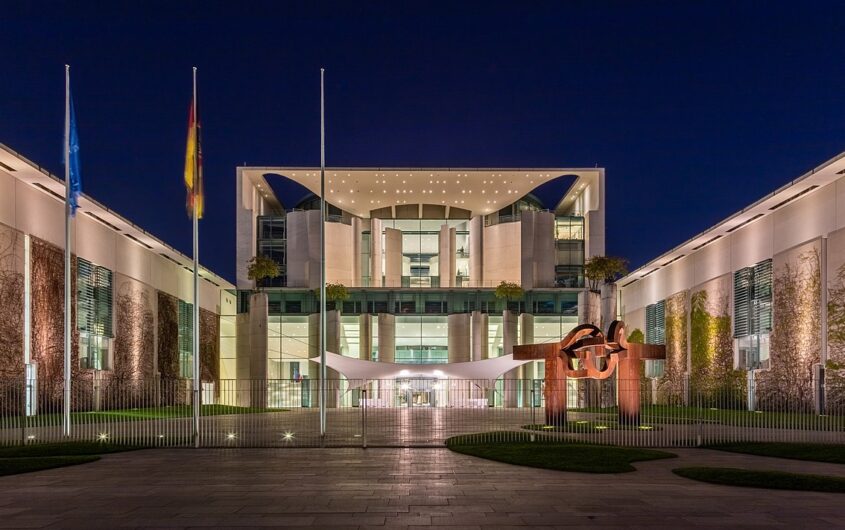
Diego Delso via Wikimedia Commons
Merz Aims to Improve Coordination, Shore up Party Support with Chancellery Shakeup

Phyllis Berry
Non-Resident Senior Fellow
Phyllis Berry is a Non-Resident Senior Fellow at the American-German Institute. She was the National Intelligence Officer for Europe from June 2021 until March 2025. She also served at the National Intelligence Council as Acting NIO for Europe from July 2017 through April 2018, Deputy NIO from April 2018 through July 2020, and senior advisor on governance for the NIC’s Strategic Futures Group during 2015-16. She authored the European futures papers for the 2017 and 2021 NIC Global Trends reports. From late 2014 to mid-2015 she was Director for Ukraine at the National Security Council. Dr. Berry has a Ph.D. in comparative politics from Georgetown University and has taught European comparative politics, French politics, German politics, and comparative leadership.
In office just eight months, German Chancellor Friedrich Merz has replaced his once closest aide as part of an effort to demonstrate his focus on economic reform, improve coordination between the Chancellery and his Christian Democratic Union (CDU) party and parliamentary caucus, and shore up support before a potentially difficult round of state elections beginning in March. On January 5, Merz’s press spokesman announced the departure of Jacob Schrot, who headed Merz’s private office and set up the government’s newly created National Security Council and staff. Philipp Birkenmaier, a CDU headquarters senior official known for his economic expertise, organizational skills, and impressive network of party contacts, will now serve as Merz’s chief assistant. Career diplomat Gunter Sautter, the Chancellery division chief for foreign and security policy, will at least temporarily oversee the preparation of NSC meetings and staff.
Adjusting the Machinery of Government While Reaching Out to His Party
Merz reportedly decided in late December to replace Schrot with Birkenmaier as part of his effort to restart his chancellorship and improve government coordination. Despite his strong foreign policy profile and international stature, Merz has struggled at home and faces a record level of dissatisfaction for a chancellor in his first year of office. He has faced repeated pushback from his parliamentary caucus over coalition compromises that some members see as watering down reforms on key issues such as pensions and military service. Some members—including Merz’s own Chancellery chief Thorsten Frei—now call for reopening the coalition agreement signed in May, and Merz has vacillated between showing sympathy for this dissatisfaction and standing by previous agreements. Meanwhile, public dissension has often delayed legislation and done little to restore faith in the government, which has declined significantly in recent years. According to polling from December, three-quarters of Germans are dissatisfied with his performance; they are also increasingly pessimistic about the country’s economic future.
As chief of Merz’s private office, Schrot played some but far from a decisive role in these difficulties. With a background in foreign policy, Schrot appeared to invest his greatest effort in building the National Security Council structure and accompanying Merz on his foreign travel, most notably when he was seated next to the chancellor at the White House in June 2025. Schrot’s predecessors never assumed such a public profile, and this attention probably added to growing Christian Democratic criticism that Schrot was failing to fulfill his chief duty—managing Merz’s daily schedule and serving as his gatekeeper. However, coalition and parliamentary relations were also not his chief responsibilities, but rather belong to Chancellery chief Frei, who has often been less than adept at these duties. Some commentators have suggested that Schrot is taking the fall for Frei’s uneven performance. Ultimately, it is Merz who, despite his three-year tenure as caucus chairman before becoming chancellor, has damaged his own messaging with off-the-cuff comments and has often appeared out of touch with his caucus.
Addressing the Need for Economic Reform
Birkenmaier’s appointment cannot solve these shortcomings, but his deeper party ties and record of working well with CDU general secretary Carsten Linnemann will likely be useful as Merz seeks to prioritize economic reform while managing the fallout from five state elections taking place this year, particularly in the case of potential first-place showings by the extreme-right Alternative for Germany in two eastern German state elections in September. On the same day that Birkenmaier’s appointment was announced, Merz sent a six-page letter to the members of his Christian Democratic and coalition partner Social Democratic parliamentary caucuses warning of the critical condition of the economy and the need for more substantial government reform to improve economic competitiveness and restore growth.
Birkenmaier’s deeper party ties and record of working well with CDU general secretary Carsten Linnemann will likely be useful as Merz seeks to prioritize economic reform while managing the fallout from five state elections taking place this year.
A first test of whether Merz can push his coalition forward on economic reform will take place at the end of the month, when the coalition committee of senior CDU, CSU, and SPD officials meet to discuss their legislative agenda. CDU members of parliament want to advance a planned cut in the corporate tax rate while the SPD is pressing for tax cuts aimed at those earning lower incomes. Merz will almost certainly have to invest more of his own time and political capital to find credible compromises if there is any chance he can improve public and business faith in the government and help to boost his own party’s chances in the upcoming state elections. He will also have to work more closely with his Chancellery chief and caucus chairmen as well as state party leaders and do a better job of managing his own messaging.
Continuing Germany’s Security Policy Maturation
Merz has made clear—and stated directly in his letter to the caucuses—that he will continue to devote considerable time and political capital to supporting Ukraine and building a European security architecture less dependent on the United States. His willingness to cross Christian Democratic redlines to do so—such as with his acceptance in late December of joint EU borrowing to provide financial and military assistance to Ukraine when his preferred option of a loan backed by immobilized Russian sovereign assets failed to win support—reflects this prioritization. His coalition has been united in support of these efforts, and the clarity in Merz’s messaging on Ukraine and European security has probably helped to consolidate what opinion polling shows is German public support for the foreign policy actions he is taking.
Although Sautter’s new role overseeing NSC operations and staff was likely motivated by a need to deal with Schrot’s departure, the result is probably positive for foreign and security policy coherence. It is a victory for diplomatic expertise, and it presents a more viable path to supporting the nascent National Security Council and integrating strategic planning more fully into foreign and security policymaking. Sautter, who prior to entering the Chancellery had no relationship to Merz, has quickly established himself as a key adviser through his expertise on Ukraine and strong working relations with his European and U.S. counterparts. Sautter was credited with organizing the Ukraine conference hosted by Merz in December that brought together U.S., Ukrainian, and European officials that helped to bring European and U.S. positions closer in line. Sautter’s inclusion in the subsequent meetings in Miami between Ukrainian, U.S., and Russian officials also indicates his success at forging ties with his U.S. counterparts.
Sautter’s twin roles should help to merge the day-to-day management of foreign and security policy with the NSC staff’s mandate to provide strategic foresight and planning. With the lack of party division between the Chancellery and Foreign Office that complicated cooperation in previous governments, Sautter is well positioned to use his own Foreign Office experience and contacts to advance Merz’s goal of having the government speak with one foreign policy voice. Merz has suggested that Germany could play a direct military role in supporting a peace settlement in Ukraine—provided that a ceasefire and Bundestag approval can be achieved. Sautter’s efficient management of foreign and security policy will help manage support for this position and will be more generally important as Merz seeks to help build a new European security architecture.
All statements of fact, opinion, or analysis expressed are those of the author and do not reflect the official positions or views of the US Government. Nothing in the contents should be construed as asserting or implying US Government authentication of information or endorsement of the author’s views.