
Catholic Church England and Wales via Flickr
Where Does the Catholic Church Stand on Migration Policy?

Kathrin Ritzka
Humboldt University of Berlin
Kathrin Ritzka is a DAAD/AGI Research Fellow in Fall 2025.
Kathrin Ritzka is a doctoral researcher and Research Associate in Catholic Theology at Humboldt University of Berlin and coordinator of the Center for Interreligious Theology and Religious Study at Humboldt University of Berlin. She holds a master’s degree in German literature from Humboldt University of Berlin, an MPhil in Theology, Religion, and Philosophy of Religion from the University of Cambridge and a bachelor’s degree with a double-major in Catholic Theology and German Literature.
Her research at AGI will examine how the Catholic Church in the United States and Germany has responded to migration policy debates between 2001 and 2025. Focusing on key turning points after 9/11, during the 2015 refugee crisis, and in the run-up to the 2024/25 elections, she investigates how Catholic leaders, institutions, and lay organizations have positioned themselves in relation to theological principles, political realities, and a shifting public discourse. On the basis of historical analysis and interviews with key actors her project compares national and transnational dynamics to understand how the Church balances universal theological commitments with local realities. In doing so, her research highlights the role of Catholic advocacy in shaping migration debates and sheds light on the broader intersection of religion and politics in democratic societies.
She is currently co-editing volumes on religion and modernity (Legitimität der Moderne: Reflexionen zwischen Dogmatik, Kirchenrecht und Geschichte, forthcoming 2026) and on language and theology as well as finishing her doctoral thesis on the notion of consolation in theology and contemporary literature.
On November 12, 2025, the United States Conference of Catholic Bishops (USCCB) released a special message at its annual conference in Baltimore, the first of its kind in the last twelve years. In a vote of 216 votes in favor, 5 votes against, and 3 abstentions, the body of bishops addressed the current situation of immigrants in the United States. They condemned the “vilification of migrants,” denounced a “climate of fear” in which families are separated, and made clear they oppose mass deportation as well as the language in which the dispute is being waged. Not least because of its history in the country, the Catholic Church is a major player in U.S. refugee relief. Due to cuts in federal funding, Catholic organizations are forced to suspend much of their activity and adapt their services to new realities.
Migration is a global and, at the same time, country-specific phenomenon. Catholic actors move between the specific contexts of individual nations and the Church as a supranational institution with its universal doctrine and tradition. For this reason, a transnational comparison can be helpful in determining the position of the Church as well as pointing toward global tendencies that further illuminate national contexts. “There is no Catholic vote—and yet, it matters,” E.J. Dionne, Jr., wrote in an article from 2000 that is often quoted with reference to the political behavior of Catholics in the United States. Dionne describes that Catholics do not vote as a block for one party or the other, but the party that ‘wins’ the majority of Catholic votes usually wins the presidency. According to Dionne, Catholics “embody the classic American progression,” pointing out their social mobility and advancement in the last decades and their tendency in not aligning fully with either U.S. political party. Behind this project lies therefore a bigger question: Can migration policy be a lens that helps us understand current tendencies of the orientation and situation of Catholics?
Catholics have a comparatively great influence in the current political landscape of the United States. The vice president is a Catholic, as are other members of the administration, for example, Secretary of State Marco Rubio and press secretary Karoline Levitt. The Supreme Court also has a majority of Catholic members. Cardinal Timothy Dolan, Bishop of New York, led the invocation at President Trump’s inauguration. He and Bishop Robert Barron are the two Catholic members of the Religious Liberty Commission convened by President Trump.
This influence in itself seems remarkable. Catholics historically found themselves positioned between the universal claims of the Church and the particular demands of the nation-state, navigating a dual allegiance that often required balancing transnational religious identity with emerging forms of national political belonging. There were periods in history in both the United States and Federal Republic of Germany (and preceding political systems) where Catholics were particularly estranged from their country’s leadership.
In the United States, Catholics, who make up roughly 20 percent of adults, are often described as a major swing-voter group. In the most recent presidential election, they voted predominantly for the Republican Party (55 percent). Since the 1960s, Catholic votes have been split almost evenly between the Republican and Democratic parties. Support of the Republican Party is higher among white Catholics, while Hispanic Catholics show higher support for the Democratic Party. Remarkably, 29 percent of U.S. Catholics are immigrants, and 14 percent are children of immigrants. In Germany, by contrast, the most frequently chosen party among Catholics in the last federal election 2025 was the Christian Democratic Union/Christian Social Union (CDU/CSU) with 39 percent of votes. (For comparison: among Protestant voters, they received only 29 percent of votes.) 24 percent of the German population are Roman Catholic; 21 percent of the population are protestant and members of the Protestant Church in Germany. In Germany the so-called “tipping point” (Kipppunkt, a term coined by sociologist Detlef Pollack in 2022) has been reached; more than 50 percent of citizens are not members of the two main Christian Churches in Germany.
The foundations for Catholic attitudes toward migration are provided by Catholic Social Teaching. Catholic Social Teaching is not a specific canon of documents but the entirety of statements made by the Roman Catholic Church concerning the social sphere. It includes principles such as human dignity, subsidiarity, solidarity, the common good, and charity. In the narrower sense, it is a product of the nineteenth century, developed in the context of the Industrial Revolution and growing social tensions. Catholic Social Teaching is contested within Catholicism and its various streams, also—and especially—with regard to migration. In the last decades in the United States, the conflict has materialized in two controversial legislative issues: migration and abortion. The issue that is given greater weight is decisive for the voting decision for one political party or the other. In current debates, both sides base their stances on these issues on theological grounds. For instance, those who hold abortion to be the central issue may point out that while an abortion is always illicit according to Church teaching, Catholic Social Teaching principles such as solidarity have no one single correct interpretation, thus hierarchizing the importance of the first issue over the latter. On the other hand, those who consider refugee aid an important task of the Church, in turn, argue that pro-life is a principle that applies to all of life and all situations (a variation of the so-called “seamless garment” doctrine). As Pope Leo argued: “Someone who says, ‘I’m against abortion but says I’m in favor of the death penalty,’ is not really pro-life. So, someone who says that ‘I’m against abortion, but I’m in agreement with the inhumane treatment of immigrants who are in the United States,’ I don’t know if that’s pro-life.”
Is the majority of Catholics in the United States, this opposition taken into account, on board with the bishops’ special message on migration policy? The answer is complicated for more than one reason. On the one hand, even bishops known for their conservative views have been protesting against certain government measures. The USCCB’s statement cannot be viewed in isolation. Rather, it is the result of tensions that have been building up over the past weeks and months. Since the inauguration of President Trump, there has been an ongoing dispute concerning immigration between the government and Catholic actors in the United States. It reached a climax in April, when the USCCB formally ended its federal government partnership on migration services, a step that was inevitable after the funding cuts made the implementation of the programs virtually impossible. On the other hand, the bishops do not only criticize the measures of the last few months. The special message calls for reform of the immigration system and emphasizes the Church’s understanding of the need of a functioning system regulating immigration. When this aspect is taken into account, the message reads like a rather moderate proposal.
Some voices expressed dissatisfaction with how the bishops handled the situation following the developments since January. Some argue the special message came too late, at a point when the political cost to get involved was low, and that the Church kept under the radar for too long. It comes after a period of time when the political efforts of the Church were directed at abortion and related issues. The most recent special message from 2013 addressed the federal government’s contraceptive mandate. The last statement in which the bishops addressed immigration was from 2003, when they issued “Strangers no Longer” together with the Mexican Bishop Conference.
The more recent debate in the United States has also been influenced by the Popes’ general stance in this matter as well as by direct interventions. Pope Francis made the humane treatment of immigrants and refugees a central topic of his papacy. His first official trip in 2013 was to Lampedusa, an Italian island where many asylum seekers and migrants from Africa arrive after risking the dangerous crossing of the Mediterranean. During his papacy, he spoke openly about the conditions and did not shy away from holding those in power accountable. His criticism also extended to the United States. He opposed JD Vance’s understanding of the ordo amoris, a theological concept about the importance of the proper order of love, in a letter. Vance defended the administration’s immigration initiatives in an interview by stating that “there’s this old-school—and I think a very Christian concept […]—that you love your family, and then you love your neighbor, and then you love your community, and then you love your fellow citizens in your own country, and then after that you can focus and prioritize the rest of the world,” thus, invoking a hierarchy between loving an American neighbor versus loving an immigrant neighbor. In direct opposition to this, Francis argued that “Christian love is not a concentric expansion of interests that little by little extend to other persons and groups.”
His successor, Pope Leo, the first U.S. pope in history, seems to employ a different rhetoric. He is less outspoken than Francis in his advocacy for migrants. Nevertheless, not only his election but also his choice of name sent a significant signal. His namesake predecessor, Leo XIII, was responsible in the nineteenth century for the Church’s first major social encyclical, Rerum novarum (1891). In the last few weeks, without directly addressing the administration, Pope Leo has taken a stronger stance, e.g., by making clear his wish for the U.S. body of bishops to present themselves in a united front with regard to the current situation of immigrants.
Confessional identities are changing and boundaries no longer run solely between religious denominations but are increasingly issue-centered.
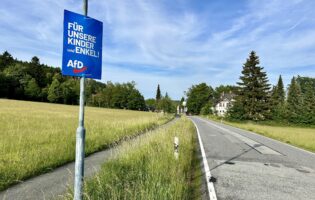
In Germany, the political situation and the urgency of the discussion are not comparable to the circumstances in the United States, but the topic also offers potential for conflict within Catholicism in Germany, reminiscent of the situation in the United States and pointing toward a complex divide. To focus attention on only two debates: In January, shortly before the elections, the CDU introduced a legislative initiative in parliament, the Zustrombegrenzungsgesetz (“Influx Limitation Act”). As a reaction to terrorist attacks in Solingen, Magdeburg, and Aschaffenburg, it proposed the tightening of immigration laws. By putting forward the initiative, the CDU took into account that the far-right Alternative for Germany (AfD) would be voting with them to pass the legislation, thus causing an outcry in the German public. The main German Churches reacted quickly by releasing a joint statement. However, a few Catholic bishops declared their rejection of the statement shortly after. Their primary objection was a proclaimed reservation against intervening in the election campaign. (Of course, the statement was readily taken up by the left-leaning parties.) The Central Committee of German Catholics’ (ZdK) reaction to the initiative caused CDU politician Annegret Kramp-Karrenbauer to resign from the committee—a noteworthy step, because there had traditionally been a close relationship between the ZdK and the CDU. More recently, Chancellor Friedrich Merz connected migration with a “problem in the cityscape” (Stadtbild). Catholic actors from different backgrounds once again publicly opposed Merz’s statement and used the opportunity to criticize his legislative measures concerning migration policy.
As both instances indicate, the development within German Catholicism cannot be considered in isolation from the question of how to deal appropriately with the AfD. Recent statements and positions are always contextualized within this question, which also significantly shapes Friedrich Merz’s chancellorship and the current development of the CDU.
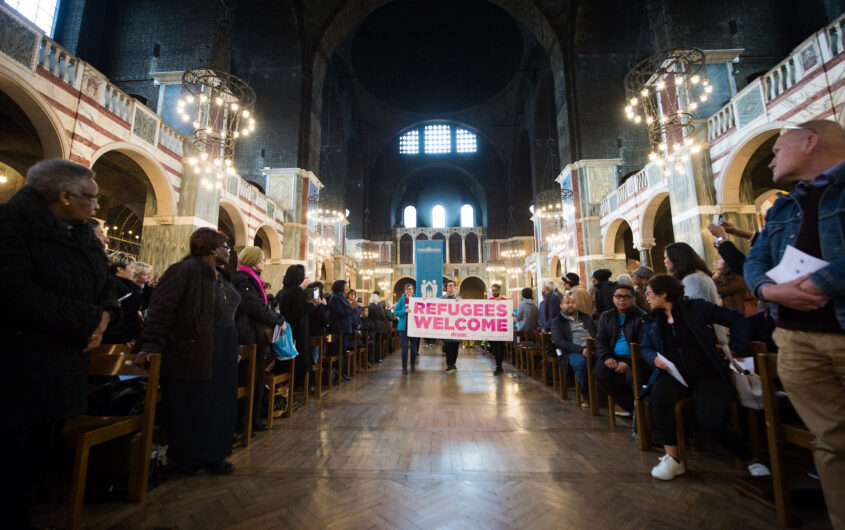
In recent weeks and months, the Catholic Church has had a relatively high media presence. Besides the papal election, the focus has regularly been on the Church’s involvement and opposition in debates and legislative initiatives concerning migration in the United States and worldwide. The tone in which the Church is reported on in this context is different from coverage in the last years. In the past, issues like abortion conveyed a politically and morally conservative image of Catholicism, and reporting on the abuse scandal and its aftermath showed an institution that is struggling to adequately handle and critically examine its past. Reporting in the context of migration paints a different picture. Reports highlight, for example, the Church’s active support of people in deportation detention and its prayer vigils and protests against detention conditions (such as the denial of sacraments and family separation) or Pope Francis’ direct confrontation with the Trump administration. The question is whether this depiction is merely an excerpt from a more convoluted panorama.
The observation that the divide among Catholics is complex also resonates in the National Study of Catholic Priests (2025) conducted by the Catholic University of America. The findings point towards a generational divide. Among the younger generations, priorities like immigration assistance and social justice rank significantly lower than they do among older generations of priests. Instead, evangelization, sharing the “Good News” of the Christian faith and inviting others to join, ranks comparatively high. The difference is gradual, but significant. It reflects broader shifts within Western religious landscapes. Confessional identities are changing and boundaries no longer run solely between religious denominations but are increasingly issue-centered—and are perceived as such. Local priests and bishops are losing authority. The global religious market (within Catholicism and beyond) allows individuals to choose the right religious community for their beliefs and convictions (religious but also political).
“There is no Catholic vote—and yet, it matters.” Twenty-five years after this thesis was published, U.S. Catholics are still no uniform group, despite their bishops’ statement passing with almost no dissenting votes. Church activism in immigration advocacy in the United States and Germany represents a snapshot showing that dissolving confessional boundaries are, for the time being, still present and continue to be recognized and interpreted as such, including in media discourse.
Supported by the DAAD with funds from the Federal Foreign Office (FF).