
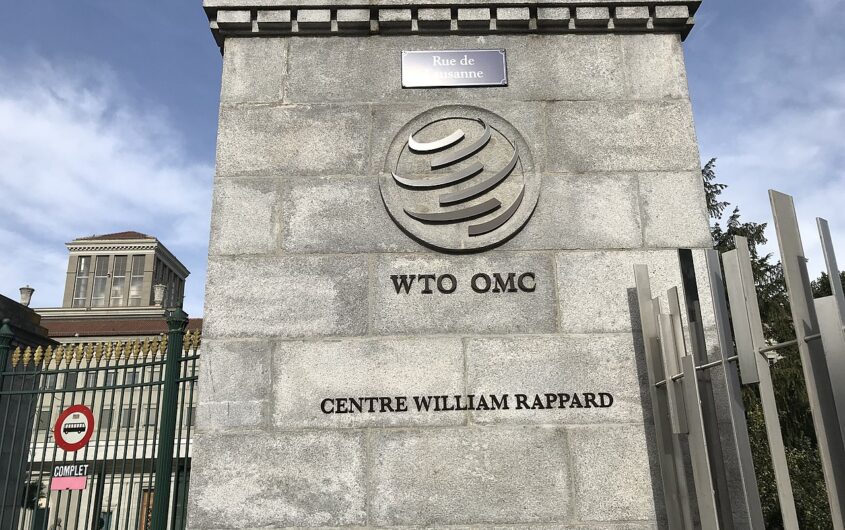
Benoît Prieur via Wikimedia Commons
The United States and WTO Reform

Peter S. Rashish
Vice President; Director, Geoeconomics Program
Peter S. Rashish, who counts over 30 years of experience counseling corporations, think tanks, foundations, and international organizations on transatlantic trade and economic strategy, is Vice President and Director of the Geoeconomics Program at AICGS. He also writes The Wider Atlantic blog.
Mr. Rashish has served as Vice President for Europe and Eurasia at the U.S. Chamber of Commerce, where he spearheaded the Chamber’s advocacy ahead of the launch of the Transatlantic Trade and Investment Partnership. Previously, Mr. Rashish was a Senior Advisor for Europe at McLarty Associates, Executive Vice President of the European Institute, and a staff member and consultant at the International Energy Agency, the World Bank, UN Trade and Development, the Atlantic Council, the Bertelsmann Foundation, and the German Marshall Fund.
Mr. Rashish has testified before the House Financial Services Subcommittee on International Monetary Policy and Trade and the House Foreign Affairs Subcommittee on Europe and Eurasia and has advised three U.S. presidential campaigns. He has been a featured speaker at the Munich Security Conference, the Aspen Ideas Festival, and the European Forum Alpbach and is a member of the Board of Directors of the Jean Monnet Institute in Paris and a Senior Advisor to the European Policy Centre in Brussels. His commentaries have been published in The New York Times, the Financial Times, The Wall Street Journal, Foreign Policy, and The National Interest, and he has appeared on PBS, CNBC, CNN, NPR, and the BBC.
He earned a BA from Harvard College and an MPhil in international relations from Oxford University. He speaks French, German, Italian, and Spanish.
While the Trump administration’s trade policy has gained attention for the series of bilateral tariff-raising deals it orchestrated in 2025, at the end of last year, the United States also put forward a position on trade multilateralism in the World Trade Organization in a communication with the short title “On WTO Reform.”
Many problems in the global trading system cannot be attributed to the rules and functioning of the Geneva-based WTO but rather to areas beyond its current mandate or what any future mandate should reasonably be expected to encompass. These include shifts in the balance of power among leading countries or domestic policy choices like economic growth driven by investment vs. consumption.
Yet the WTO operating system does need updating to account for changes that have occurred since its founding in 1995.
China is no longer the developing country it was thirty years ago but rather a manufacturing powerhouse whose overproduction in several sectors challenges U.S., German, and European industry and technology. Supply chains are now spread across the world in a way that elevates the importance of resilience and security in international trade. And because of a growing diversity of interests in the international economic system, there needs to be greater leeway for like-minded countries to pursue agreements among themselves (plurilateralism).
In its paper, the United States addresses the three areas that are part of ongoing reform discussions—decision-making (the need for consensus), special and differential treatment (privileges for poorer member countries), and level playing field (reporting transparency and compliance).
Whether it is on industrial policy and subsidies, energy and climate, artificial intelligence, or supply chains, the WTO does need to allow more room for coalitions of the willing to strike out on their own.
Of these, the question of decision-making and how countries can move forward on new trade rules is the most consequential for the future. The U.S. communication puts it this way: “Reaching consensus among 166 Members on new, substantive agreements of any significance is very unlikely, given the wide differences in Members’ economic systems and levels of ambition. Members may have wrung all they can from multilateral negotiations.” Whether it is on industrial policy and subsidies, energy and climate, artificial intelligence, or supply chains, the WTO does need to allow more room for coalitions of the willing to strike out on their own.
The U.S. communication also raises concerns about seven points that are currently beyond the scope of current reform deliberations. Among these, several are considered too difficult for the WTO to manage: trade imbalances (surpluses and deficits), manufacturing overproduction, economic security, and supply chain resilience. The first will be better handled by either domestic policies or other international fora. But the others could be addressed by plurilateral agreements among select members. The U.S.-EU Global Agreement on Sustainable Steel and Aluminum (GASSA)—launched in October 2021 but never concluded—is one such example.
The U.S. critique also surrounds three areas where it believes action is necessary and possible in the WTO: the Most-Favored Nation principle or MFN (non-discrimination) enshrined in WTO Article I, the role of the WTO secretariat, and essential (read national) security.
Here, the U.S. position that MFN is obsolete because of divergences among members that have arisen in the trading system is potentially the most disruptive. MFN provides important predictability that benefits all WTO members. Eliminating it from the WTO toolkit without something to replace it would lead to uncertainty and complexity that could deter business investment. A better, if slower, approach would be to work out particular areas where more flexibility is needed. The WTO needs to address systemic unfairness, but not at the cost of disorder.