
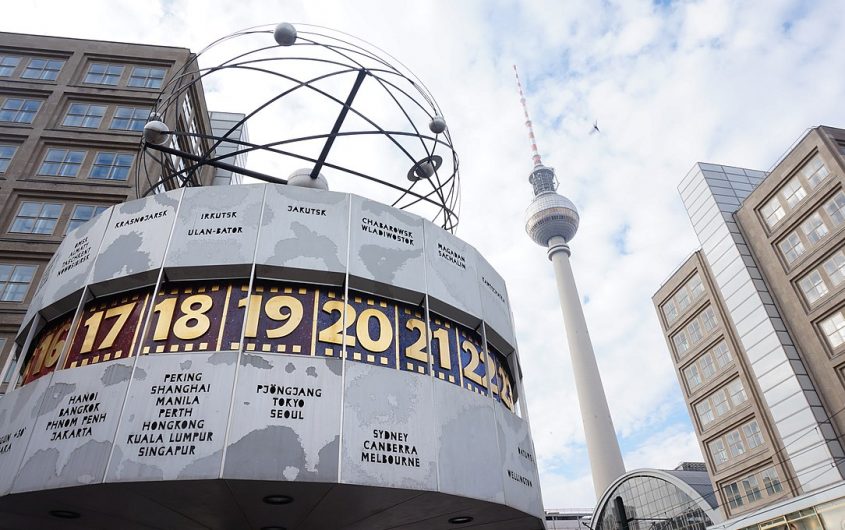
Berlinuno via Wikipedia
German Reunification: New Possibilities, New Perspectives, and Our Future Now In Our Hands
Antje Nötzold
University of the Bundeswehr Munich
Dr. habil Antje Nötzold is a Senior Researcher in the Project “Support for Arms Control in Space (SACS)” at the University of the Bundeswehr Munich.
She is also a Private Lecturer at the Department of International Relations at Chemnitz University of Technology, a Non-Resident Fellow at the American German Institute (AGI), Washington DC, an Associate Fellow at CASSIS (Center for Advanced Security, Strategic and Integration Studies) at the University Bonn, a member of the SichTRaum (Security and Technology in Space) research network, and Vice-President of the Germany-wide Gesellschaft für Sicherheitspolitik (Society for Security Policy).
After studying political science and business administration in Chemnitz and Sydney, Nötzold completed her doctorate with a thesis on European and Chinese energy policy and the implications for European energy security (Die Energiepolitik der EU und der VR China. Handlungsempfehlungen zur europäischen Versorgungssicherheit, VS Verlag für Sozialwissenschaften, Wiesbaden 2011). Her habilitation thesis was dedicated to "The Decision to Denuclearize. A Process Analysis of Nuclear Disarmament in South Africa and Implications for Non-Proliferation Research and Policy"(Nomos Verlagsgesellschaft 2023). The anthology Strategischer Wettbewerb im Weltraum (Springer, 2024), edited under her lead, is the first comprehensive summary of strategic developments, trends, and challenges in space for the German-speaking world since the end of the Cold War. She is also the editor of the Nomos publication series Non-Proliferation, Disarmament & Arms Control (“Nichtverbreitung, Abrüstung & Rüstungskontrolle”) and “Governance, Sicherheit und Nachhaltigkeit im Weltraum | Governance, Security and Sustainability in Space” as well as “Young Academics: Outer Space” at Tectum and, in addition to scientific articles in various journals and anthologies, has also published concise formats like policy papers with political recommendations.
Her research interests include astropolitics, strategic competition, rivalry, conflicts, security, and warfare in space, space governance; geopolitical rivalries and systemic conflict between the United States and China; energy policy and security of supply, the nexus of energy, climate and geopolitics; and nuclear non-proliferation. Her expertise and many years of experience in science communication and political education make Dr. Nötzold a nationally and internationally sought-after speaker and interview partner for newspapers and television.
The “Wende” and finally the termination of the GDR turned the world upside down for the people in eastern Germany. On the one hand, it changed their daily lives in a positive way with the new opportunities of free travel and an unknown richness of consumer goods. No more queueing for bananas, like a running gag about East Germans goes. Nevertheless, on the other hand it meant uncertainty for families with regard to the rapid all-encompassing unemployment and restructuring of many aspects of work. Our parents often struggled with the changes in their everyday working lives, some even being the “losers” in the rearrangement of the system when their company closed or the professions they trained for vanished. For my generation, in their early years in school when the country united, the discomfiture was perceptible and we questioned how our future would be in this new country. The look into the future was not always pleasant, especially in the 1990s, with high unemployment in the east misleading many to think our prospects would not be particularly rosy. And while it was foreseeable with the aging “Babyboomer” generation and the decline in the birth rate after 1990, no one talked about the coming shortage of skilled labor. However, we did not notice the biggest changes for our personal futures at first: it was not restrictions that determined our development, but rather independence and self-determination.
It was not restrictions that determined our development, but rather independence and self-determination.
Not only the school system and teaching content changed; it was an especially big change in the criteria about the path each of us could pursue. In GDR times government authorities decided who would gain admission to “Oberschule” (secondary school), the possibility to do one’s A levels, about a place at a university, and the field of study based on you and your family’s mindset and attitude toward the ruling Socialist Unity Party of Germany (SED). In contrast, now our educational choices and our qualifications were in our own hands (or heads). Our performance and minds became the decisive factors for our future. The world was at our feet. However, we first needed to acquaint ourselves with the abundant possibilities to work and study abroad and to actually explore the world.
I profited incredibly from these possibilities. As a student, I studied in Australia and did an internship in Brussels. Later, I took advantage of opportunities for research trips to China and the United States, for transatlantic exchange programs, international conferences, and academic exchanges in more than a dozen further countries. And yet, I am just one example out of countless young people, starting with my generation of “Wendekinder,” who could benefit from an open door to the world and now have international contacts on a regular or even daily basis and are naturally part of an international community.
Thus, from my perspective the biggest benefit, I would even say gift, of 1990 is not only that the Iron Curtain fell due to the courage of our parents’ generation. Together with huge political effort in both parts of Germany we achieved reunification, opening up the world for my generation and giving us the possibility of a new future. Many used the new freedom and opportunities, which today are regretfully often taken for granted, to expand their horizons. Occasions like thirty years of reunification should remind us not to forget these achievements and opportunities—and to be grateful.